


Funding management and grant disbursement tracking
Funding moves through three stages most incubators track in three unrelated files. EcoSync models the source, the allocation to a program, and the tranche that reached a startup as one chain - so the answer to “where did this money go” is a query, not an afternoon.
Three stages, one chain
Money enters your incubator from somewhere specific: a central or state scheme, a corporate CSR commitment, a university corpus, a philanthropic grant. That is the funding source, and it has a fixed size and its own reporting expectations.
From that source you allocate an amount to a program. From that allocation you disburse tranches to individual startups, usually against milestones.
Handled in separate spreadsheets, these three stages drift apart within a quarter. Handled as one chain, each disbursement traces back through its allocation to its source, and the totals cannot silently disagree.
- Funding source - where the money came from, and how much of it there is
- Allocation - how much of that source is committed to a given program
- Disbursement - the tranche that actually reached a specific startup
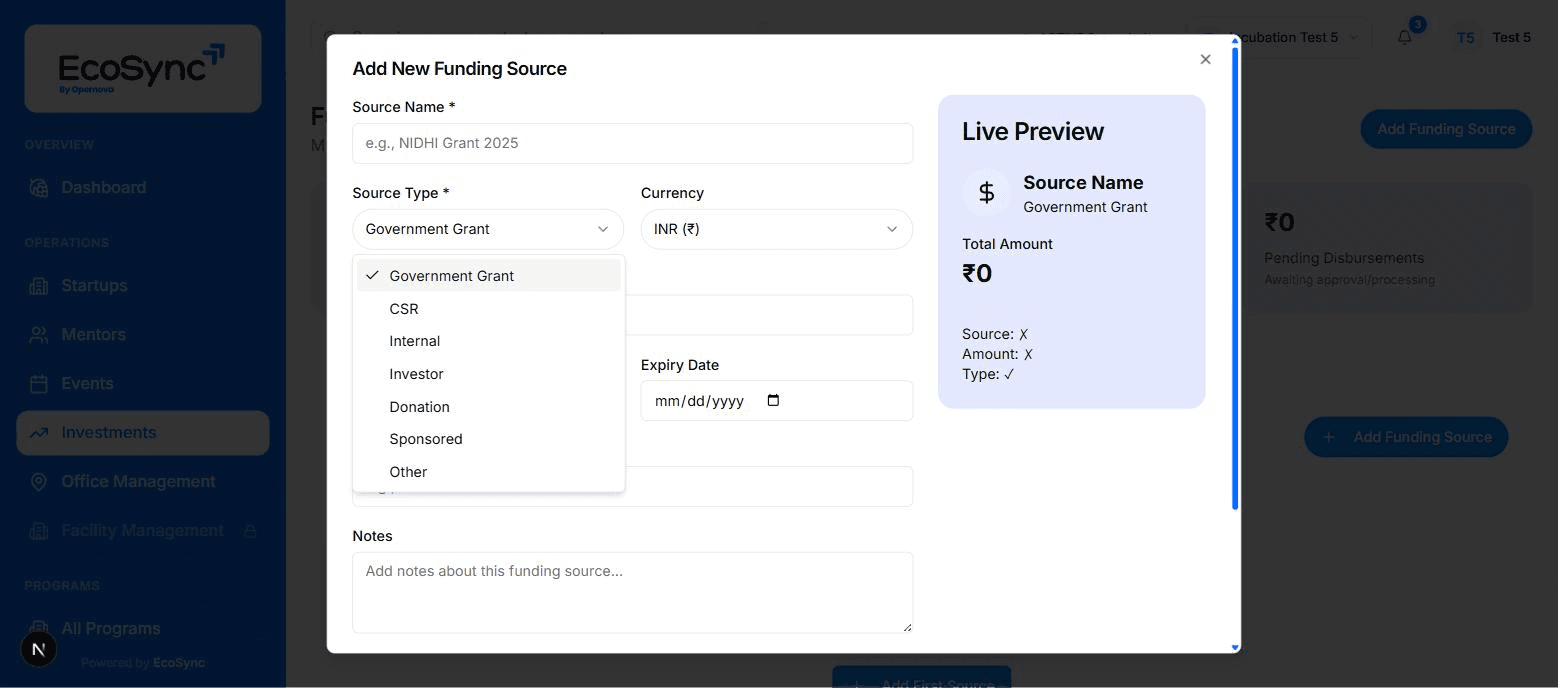
Over-allocation is blocked, not discovered
The most expensive funding error is committing more from a source than the source contains, and finding out at reporting time.
Allocations are checked against the remaining balance of the source at the point of entry. You cannot allocate a program more than the source has left. The remaining balance is visible while you are making the decision, rather than being something you calculate afterwards to check whether you got away with it.
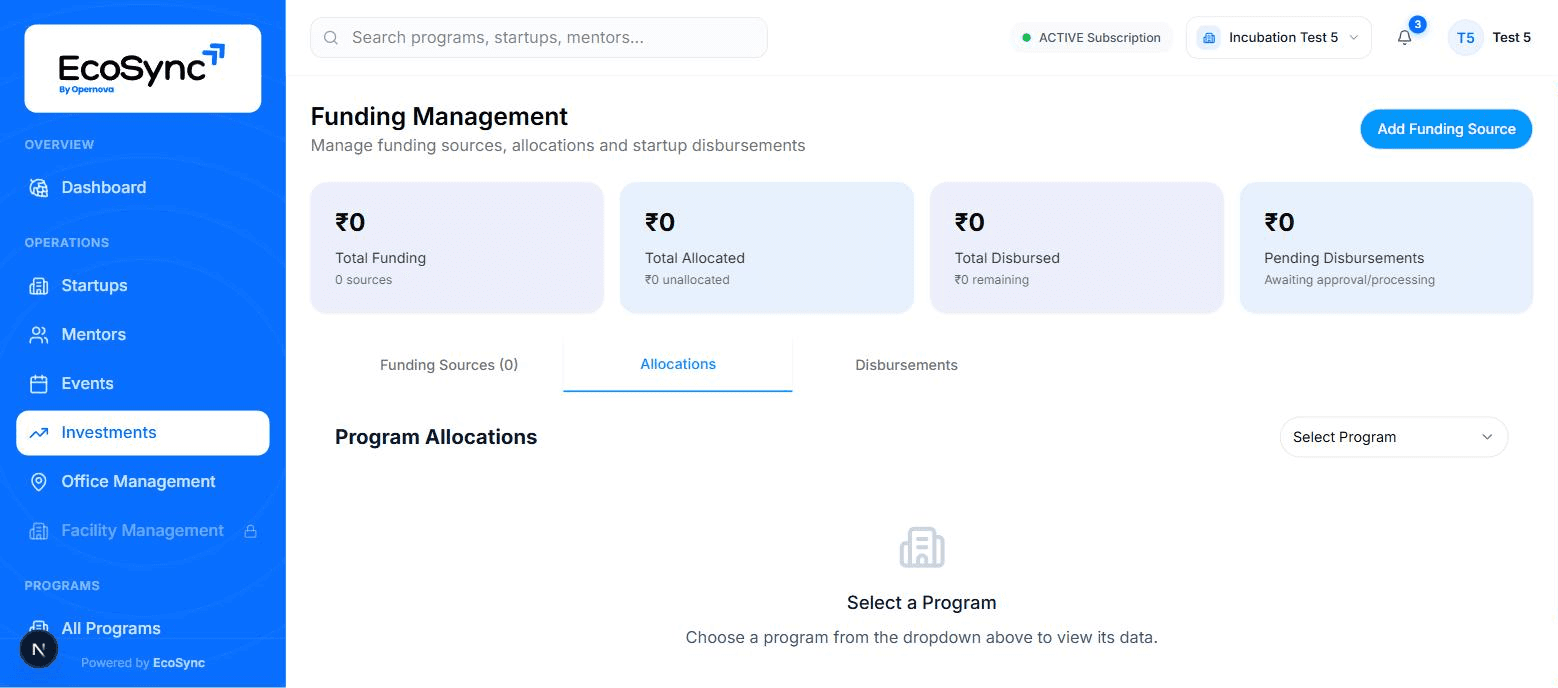
Requests, approvals and the approved amount
Startups can raise funding requests themselves rather than emailing a program manager. That request carries a state, so the founder can see where it is without asking.
Approval is not a yes or no. An approving officer can set an approved amount that differs from the requested amount - which is what actually happens in practice, and which most tools force you to record in a comment field. Here the request, the decision, the approved figure and the eventual disbursement are one record.
Startup-initiated requests
Founders raise requests in the portal with a visible status, so the funding conversation stops being an email thread with no state.
Approved amount override
Approve a different figure to the one requested, recorded as a first-class field rather than a note.
Milestone-based tranches
Disburse against milestones rather than in one lump, with each tranche recorded separately.
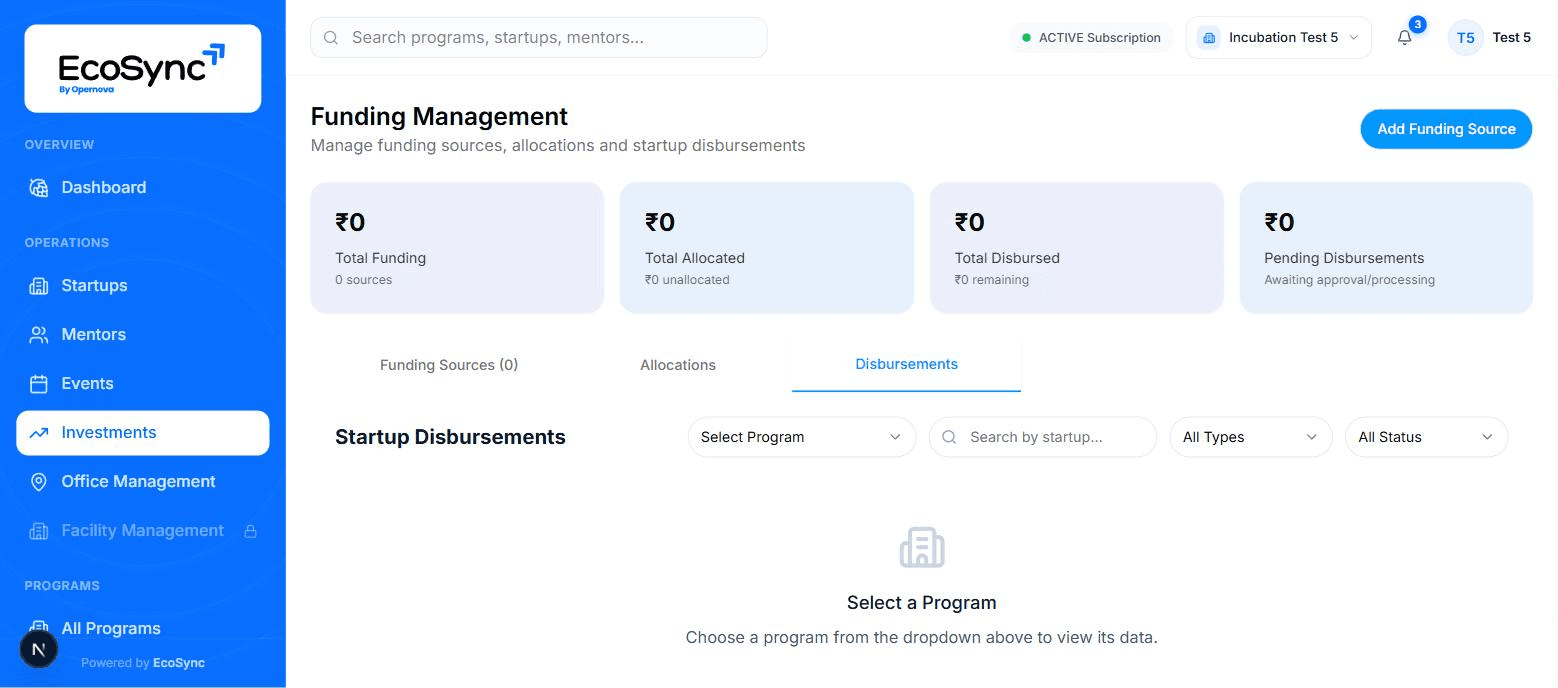
Disbursement status
Every tranche carries its own state, so what has been committed and what has actually moved are never the same number by accident.
Why this matters for grant reporting
If your funding comes from a government scheme or an institutional funder, the reporting requirement is not a summary total. It is a specific question about a specific disbursement, often asked long after the person who made it has moved on.
Because the chain from source to allocation to tranche is intact, and because every action is logged with who and when, you can answer at whatever level the question is asked - per source, per program, per startup, per tranche. Portfolio views roll the same records up for a board pack without a separate data pull.
GST and TDS are calculated per transaction, so the figures in your reporting match the figures that actually moved.
Funding in the context of a startup's whole record
A disbursement is not an isolated financial event. It sits against a startup that applied to a program, was evaluated by a panel, was onboarded into a batch, has tasks and milestones, and possibly occupies a desk you are also invoicing.
All of that hangs off one startup profile. When you open a startup you see its applications, evaluations, funding, office allocation, facility bookings and mentorships together - which is usually the moment someone notices something a spreadsheet was hiding.
Questions people actually ask
Can we track funding from more than one source?
Yes, and that is the intended shape. Each source is recorded separately with its own total. Allocations to programs are drawn from a specific source, and every disbursement traces back through its allocation to that source - so you can report per funder without untangling anything.
What happens if we try to allocate more than a source holds?
It is blocked. Allocations are validated against the source's remaining balance at the point of entry, and the remaining balance is visible while you are making the decision.
Can startups request funding themselves?
Yes. Startups raise funding requests from their own portal view, and the request carries a visible status. An approving officer can set an approved amount that differs from the requested amount, and that figure is recorded as a proper field rather than a comment.
Does it support milestone-based disbursement?
Yes. Funding can be released in tranches against milestones, with each tranche recorded separately and carrying its own status, so committed and disbursed amounts never blur together.
Is there an audit trail on funding actions?
Yes. Funding actions are logged alongside application, task and announcement history, with the person and timestamp. That record is what makes a disbursement from two years ago explainable.
Are GST and TDS handled?
Yes, calculated per transaction rather than reconciled afterwards, so reported figures match what actually moved.
Related
- Incubation management software
- For government incubators
- Documentation: funding management
- Documentation: startup management
Guides on this topic
- ESOPs for Indian Startups: A Practical Guide
How employee stock option plans actually work - pool sizing, vesting, cliffs, strike price, exercise windows, and the tax event that surprises employees at the worst time.
- Burn Rate and Runway: The Two Numbers That Decide Everything
How to calculate gross burn, net burn and runway, what a healthy runway actually looks like, and why the month you should start fundraising is earlier than you think.
- How to Write a Startup Grant Proposal That Gets Read
Grant evaluators read hundreds of proposals against a rubric. Here is what that rubric usually contains, and how to write for it without turning your startup into a research paper.
- Cap Tables and Equity Dilution for First-Time Founders
What a cap table records, how dilution works across rounds, how founder equity should be split and vested, and the cap table mistakes that are expensive to undo.
- Why Profitable Startups Run Out of Money
Profit is an accounting opinion; cash is a fact. How the gap opens up through receivables, inventory and timing, and how to manage working capital before it manages you.
- How to Find and Approach Angel Investors in India
Where angel investors actually are, what makes an intro warm, what belongs in a first email, and the follow-up discipline that separates funded founders from persistent ones.
Trace a real disbursement end to end
Bring a grant you are currently administering. We will model the source, allocate it to a program and disburse a tranche, so you can see exactly what the audit trail looks like.
Book a walkthroughReady to Join
the Ecosystem?
Book a demo

For everyone on the network
For incubators and accelerators
EcoSync is a product of Opernova Technologies LLP.
Running an incubator or accelerator? EcoSync for incubators
© 2026 Opernova Technologies LLP. All rights reserved.