


Incubator management software in India, built India-first
EcoSync is incubator management software designed for Indian incubators, accelerators and technology business incubators - INR by default, GST and TDS handled per transaction, payouts to bank or UPI, IST scheduling, and the funding traceability that grant reporting demands.
India-first is a set of specifics, not a slogan
Most incubation tooling is built for a North American accelerator and then localised badly. The gaps show up in exactly the places that cost an Indian incubator time.
EcoSync defaults to INR. Platform fees, GST and TDS are calculated per transaction rather than reconciled afterwards. Payouts reach a bank account or a UPI ID. Scheduling assumes Asia/Kolkata. Recurring office rent runs on Indian payment rails, and revenue from space you let out is transferred to your own account after verification.
Currency, timezone and language are configurable, so this is a sensible default rather than a hard constraint.
- INR default, with configurable currency
- GST and TDS computed per transaction, not reconciled later
- Payouts to bank account or UPI
- Asia/Kolkata default timezone
- Recurring rent and one-time payments on Indian rails
Built for how Indian incubators are actually funded
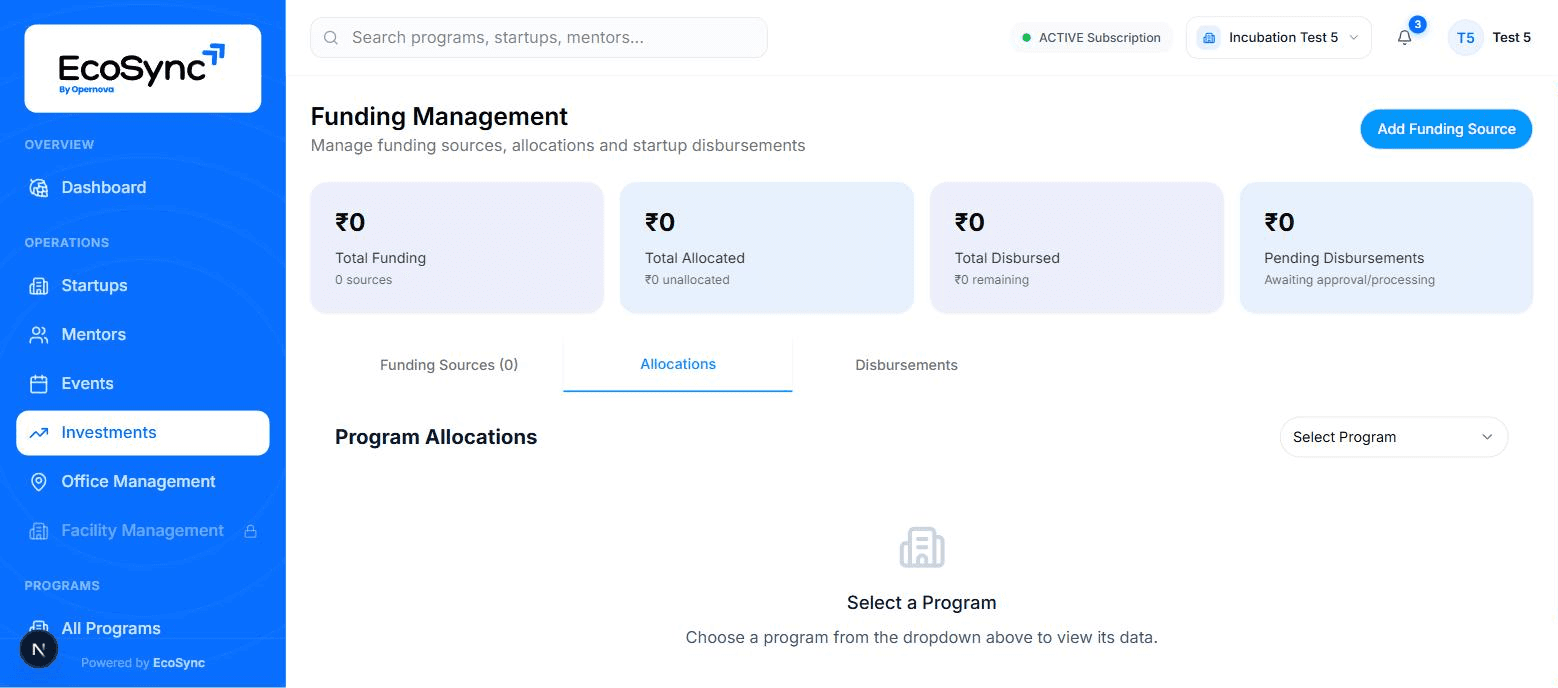
An Indian TBI or university incubation centre rarely funds startups from a single pot. Money arrives from a central or state government scheme, a corporate CSR commitment, a university corpus, or a combination - each with its own reporting expectations and its own timeline.
EcoSync models the funding source explicitly, then the allocation from that source to a program, then each tranche disbursed to a startup. Over-allocating a source is blocked at the point of entry rather than discovered during an audit. When a funder asks which of their rupees reached which startup and when, the answer is a query rather than a week of reconstruction.
Evaluation that survives a governing body meeting
University and government-affiliated incubators answer to committees. A selection decision has to be explainable months after it was made, sometimes to people who were not in the room.
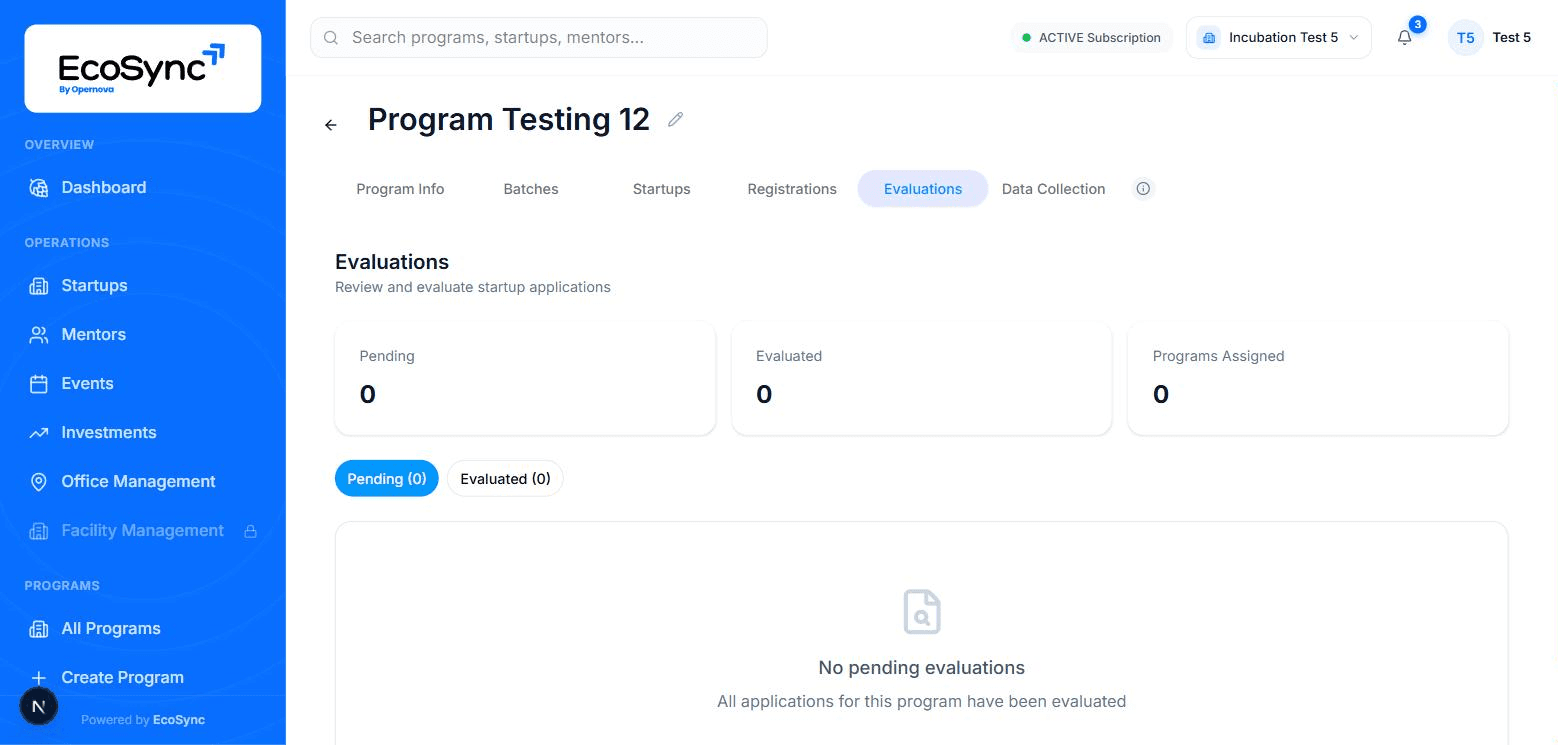
A weighted rubric with scored options gives you a defensible number rather than a remembered impression. Multiple panel members score independently, and the system keeps the per-evaluator breakdown rather than flattening everything into an average. Combined with an audit trail on every application status change, the record of how a cohort was selected stays intact.
Panel members can be external domain experts added for a single program, without granting them access to the rest of the portal.
Space and facilities as a managed revenue line
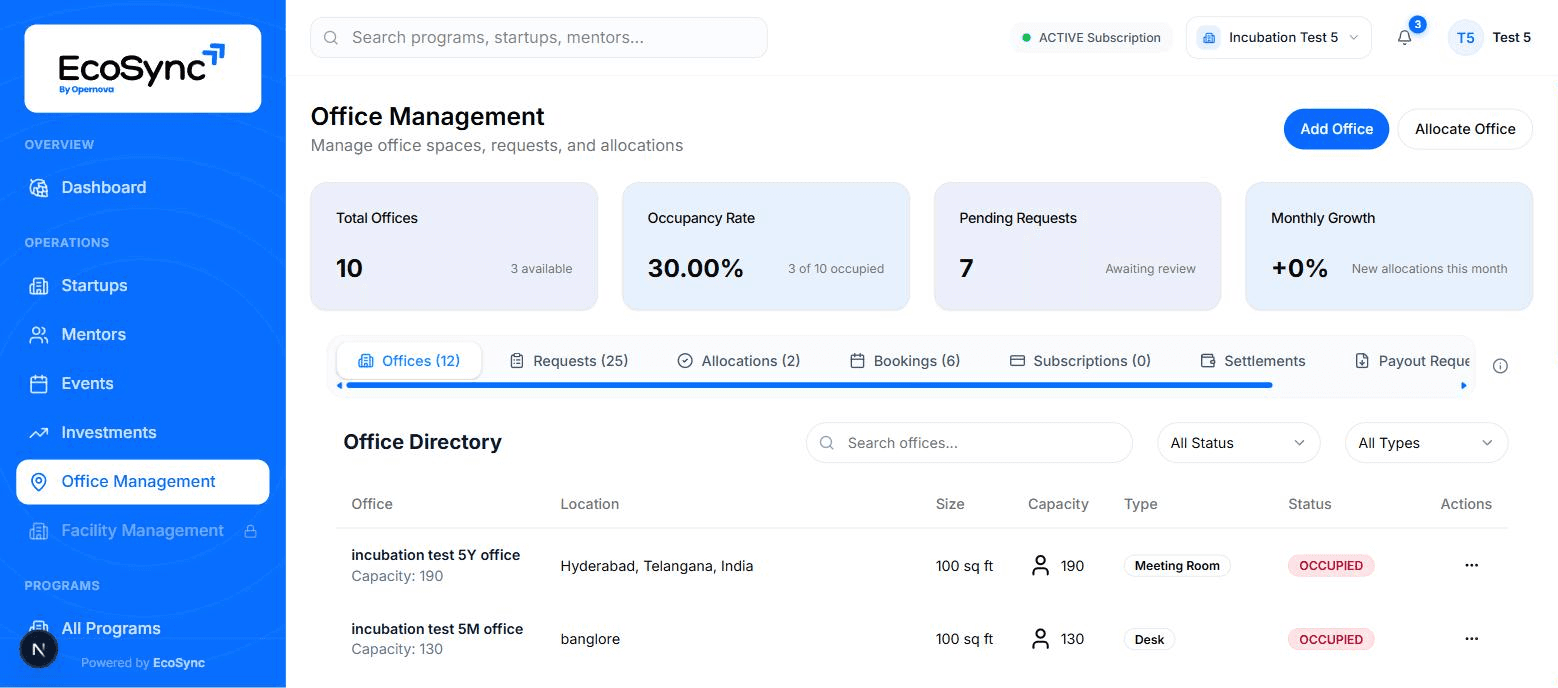
Indian incubators frequently run real estate - desks, cabins, labs, prototyping facilities - and it is often the most under-managed asset they have.
Office space supports five pricing tiers with deposits and recurring rent, and the revenue is transferred to your account after verification rather than pooled somewhere you cannot see. Facilities such as labs and meeting rooms are bookable against day-of-week time slots with an approval workflow, which replaces the shared calendar and the WhatsApp group.
One portal, many stakeholders
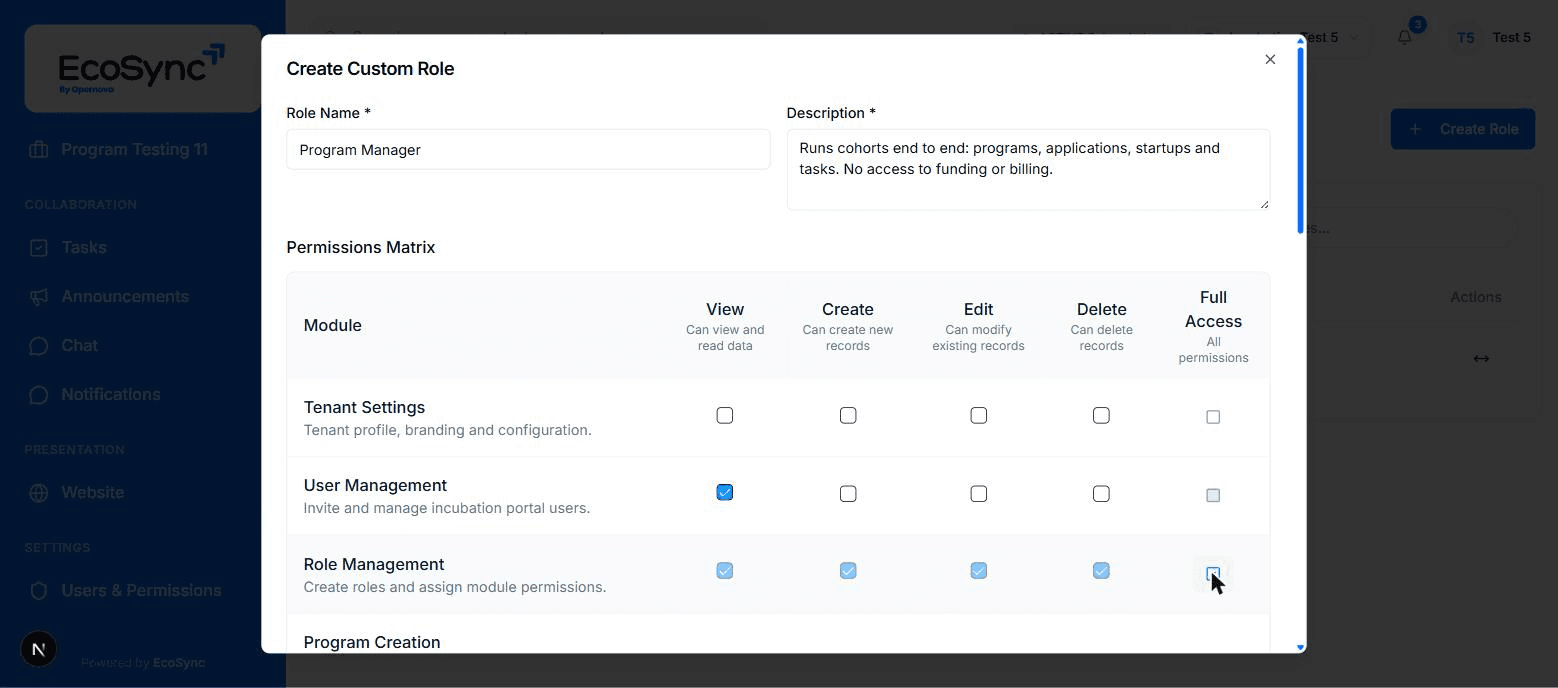
An Indian incubation centre typically has a program manager, an operations head, a finance person, a set of external mentors, a governing body, and startups at several stages at once. Giving all of them the same access is not workable, and giving them separate tools is how information gets lost.
You set what each role can do - view, add, change, remove, or manage the whole area - and override it for one person where a role is not the right shape. A finance lead can work on funding without touching evaluation. An analyst can screen applicants without the authority to approve one. Startups get their own view into your centre, so they can check where their application and their money stand without emailing you.
Connected to an Indian founder network
Your workspace sits alongside a public network of founders, mentors, investors and people looking for work, and the same account opens both. For an Indian incubator that matters most in two places: who applies, and who you can put in front of them.
Your programs become discoverable to founders who were not already in your network, rather than depending entirely on outreach. Mentors you want to bring on may already have a profile, with expertise, availability and reviews. And mentor arrangements can be structured as incubator-pays, startup-pays, subsidised, retainer or free - so mentorship can be offered as a program benefit with the cost under your control.
Questions people actually ask
Is EcoSync suitable for a government-affiliated TBI?
Yes, and the funding and audit features were shaped by that use case. Funding is modelled as source, then allocation to a program, then tranche disbursement to a startup, with over-allocation blocked. Every application status change, task, funding action, announcement and permission denial is logged. That is the record grant reporting and governing body review actually require.
Does it handle GST and TDS?
Yes. Platform fees, GST and TDS are calculated per transaction across sessions, bookings, tickets and office rent, so amounts are correct at the point of payment rather than reconciled at quarter end.
Can we take payments and receive payouts in India?
Yes - subscriptions, one-time payments and recurring office rent all run on Indian payment rails, and revenue from office space is transferred to your own account after verification. Mentors and other recipients can withdraw to a bank account or a UPI ID.
Can we apply our own branding?
Yes. Your workspace carries your logo and brand colours throughout. There is no software to install and no server to run - your team signs in and lands directly in your incubator's workspace.
We run several programs from different funding sources. Does that work?
That is the intended shape. Each funding source is recorded separately, allocations to programs are drawn from a specific source, and each disbursement to a startup traces back through that chain. You can report per source, per program or per startup without reconstructing anything by hand.
What does it cost for an Indian incubator?
Four things decide it: how many of your team need accounts, how many startups you will hold, how much document storage you need, and which parts of the portal you switch on. You can pay monthly, yearly or weekly, and run a pilot first. Because that mix differs so much between centres, the current figure sits on your plans screen after sign-in. Get in touch and we will take you through it.
Related
- Incubation management software
- For university incubators
- For government incubators
- Funding management
- Documentation: funding management
Guides on this topic
- Private Limited vs LLP vs OPC: Choosing a Structure in India
The three structures Indian founders actually choose between, what each costs to run, and the single question that settles it: are you raising equity or not?
- The Startup Compliance Calendar: What Indian Founders Must File
A plain map of recurring filings for an early-stage Indian company - company law, tax, payroll and GST - and how to keep them from eating a founder's month.
Talk to us about your programs
Tell us how your incubator is funded and how you currently select a cohort. We will show you the parts of the platform that map to it - and be straight with you about the parts that do not.
Book a walkthroughReady to Join
the Ecosystem?
Book a demo

For everyone on the network
For incubators and accelerators
EcoSync is a product of Opernova Technologies LLP.
Running an incubator or accelerator? EcoSync for incubators
© 2026 Opernova Technologies LLP. All rights reserved.