


Incubation management software that runs the whole program
EcoSync is incubation management software for incubators, accelerators and technology business incubators. One white-labelled portal for applications, weighted panel evaluation, office space, facilities, funding and reporting - with an audit trail on every decision.
The problem is not the program. It is the tooling around it.
Most incubation teams do genuinely good program work on top of tooling that fights them. Applications arrive through a form builder. Evaluation happens on a shared spreadsheet. Documents are chased over email. Grant tranches are reconciled by hand at the end of the quarter, from three different places.
That holds together at twenty applications. At eighty applications with five panel members, twelve outstanding documents and a government grant split across three tranches, it stops holding together - and the time goes into administration instead of the founders.
Incubation management software is not a form builder with better styling. The difference is whether the system can hold a weighted rubric across multiple evaluators, keep a status on every document you have asked for, and tell you where a specific rupee went eight months later.
- A form cannot give you comparable scores across five evaluators and two cohorts
- A spreadsheet cannot tell you who changed an application's status, or when
- An email thread is not a document-request workflow with a state
- A folder of receipts is not funding traceability
Programs, end to end
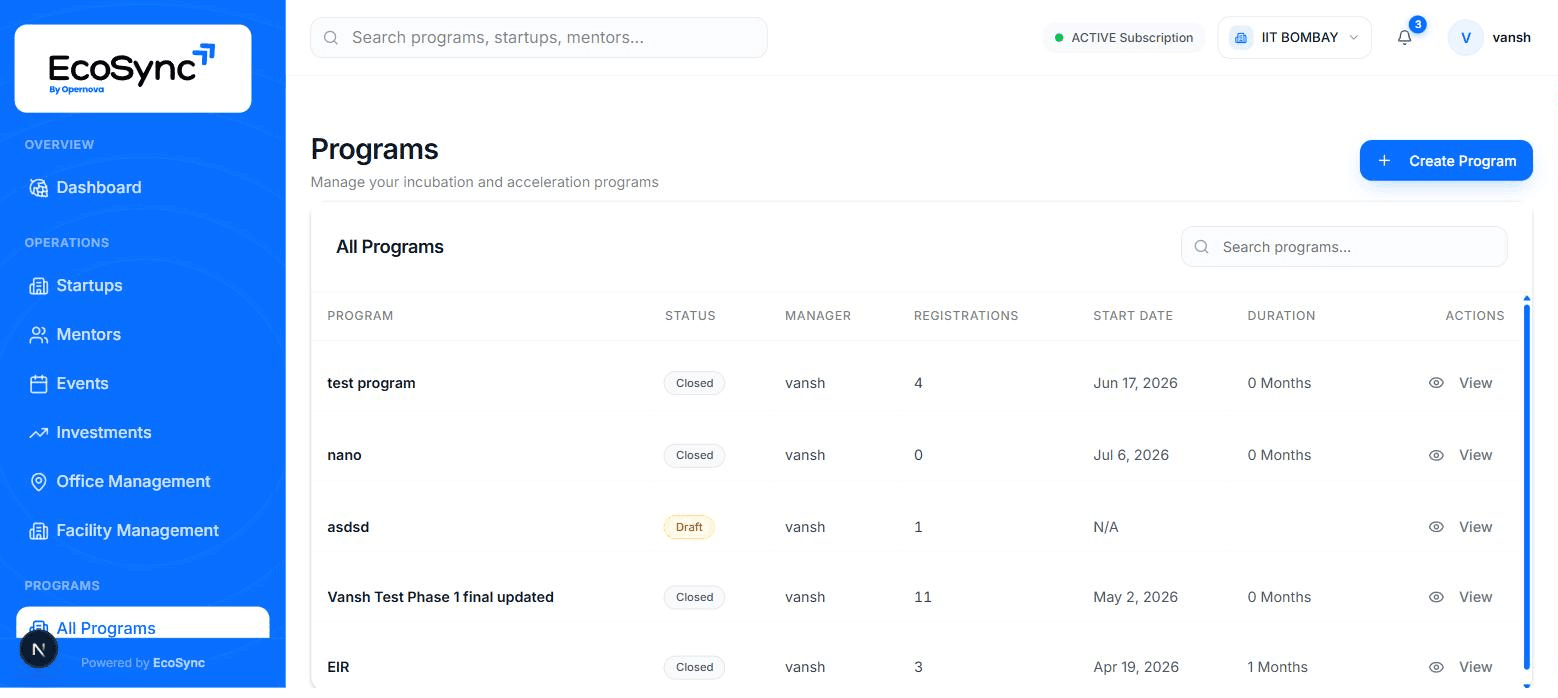
Build a program, define its application form, open a batch, and take applications through to onboarding without leaving the portal.
Application forms are built from eight question types with a reusable question bank, so the fourth program you launch does not mean rebuilding the same twenty questions. Batches sit inside a program, which means Batch 1 and Batch 5 can run side by side without duplicating the program itself.
Custom application forms
Eight question types and a reusable question bank. Ask exactly what your program needs, and stop rebuilding the same form every cohort.
Batches inside a program
Run concurrent cohorts under one program definition, with bulk startup registration where you already know who is coming in.
Twelve application statuses
A real pipeline rather than a spreadsheet column, with a full audit trail recording who moved an application and when.
Change and document requests
Ask an applicant for a missing document from inside the system and track its state. The chase stops living in your inbox.
Evaluation you can defend to a committee
Panel evaluation is where spreadsheets do the most damage, because the damage is invisible. Two evaluators scoring out of ten with no shared rubric produce numbers that look comparable and are not.
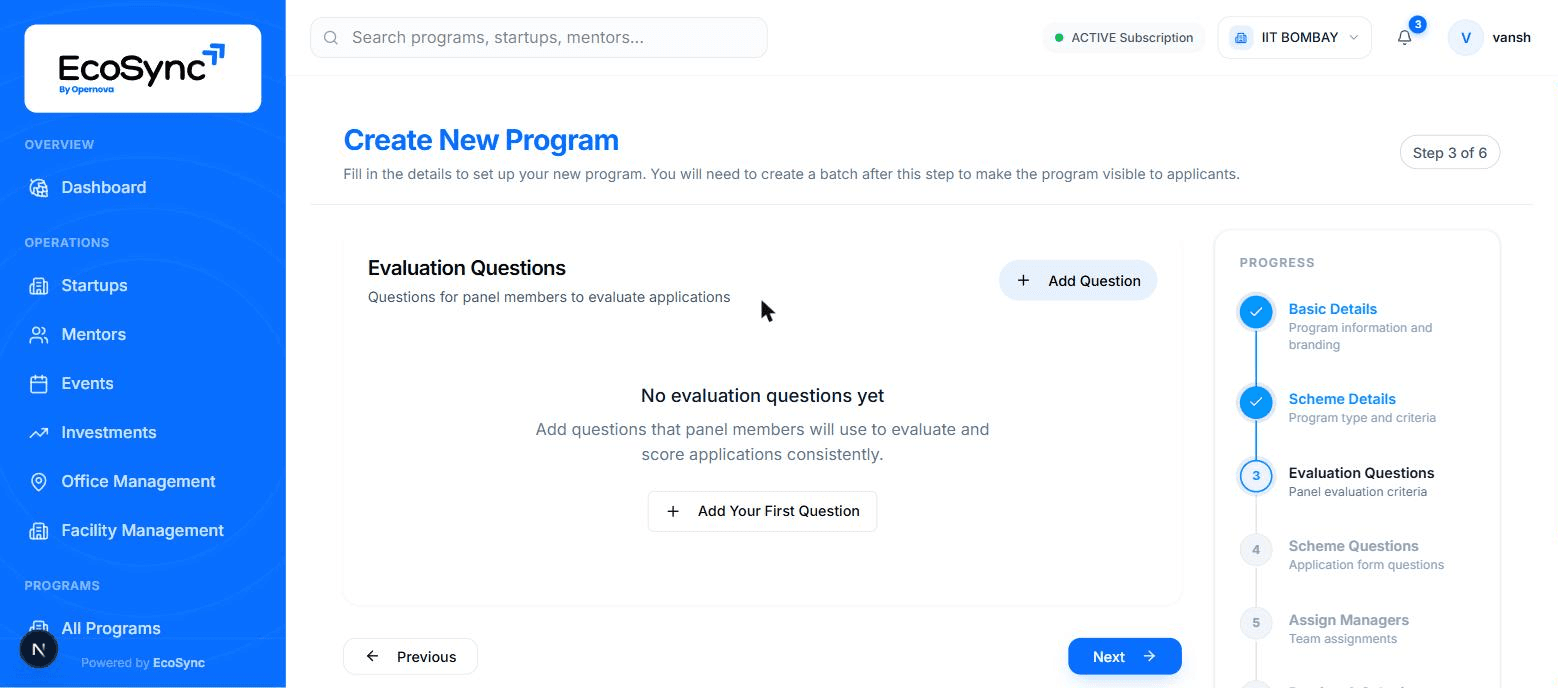
In EcoSync you define a rubric of weighted questions with scored options. Panel members are assigned to specific programs and can only evaluate applications inside those programs. Each evaluator scores independently, and the system aggregates a per-evaluator breakdown, per-question averages and a total weighted score.
External experts can be added as panel members without being granted a full portal role - so you can bring a domain specialist in for one program without giving them access to everything else.
Money you can trace
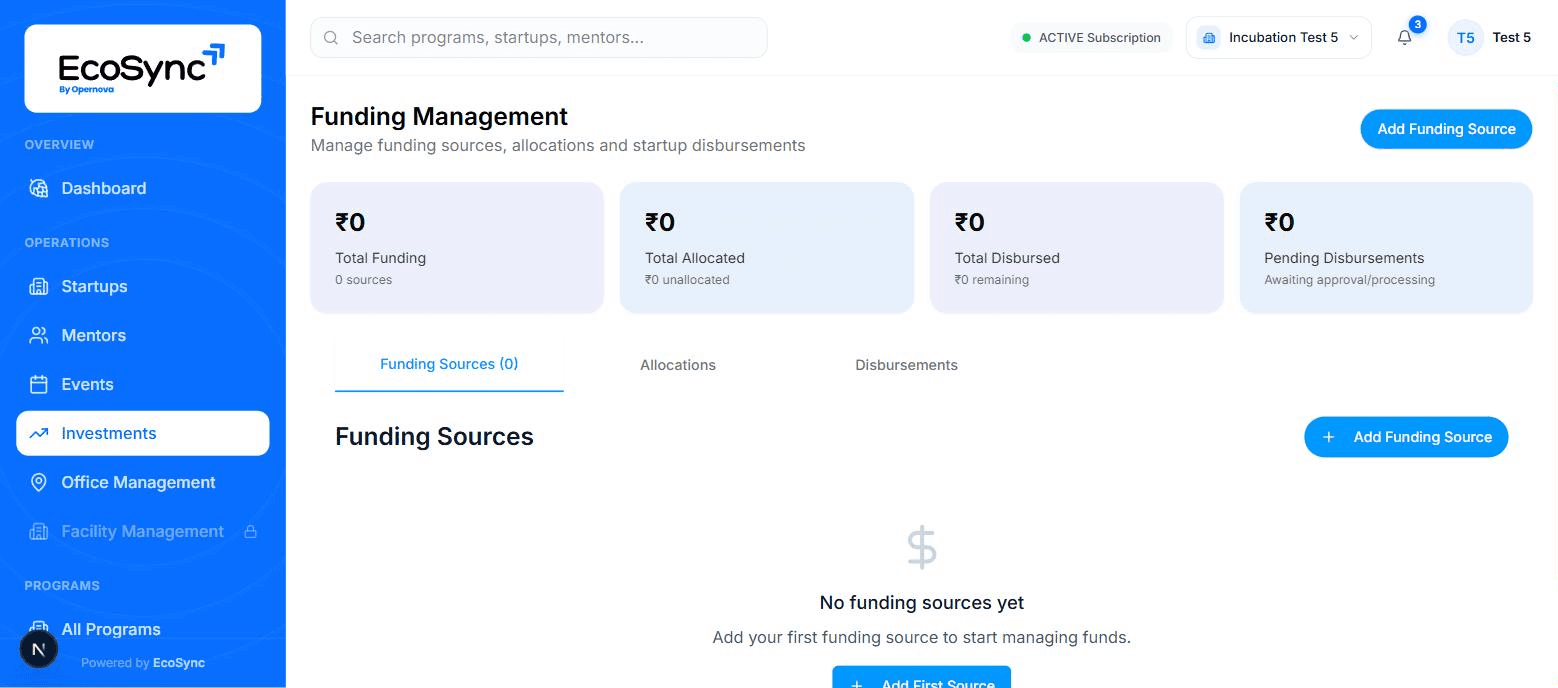
Funding moves through three stages that most incubators track in three unrelated files: the source it came from, the program it was allocated to, and the tranche that actually reached a startup.
EcoSync models all three as one chain. Over-allocating a source is blocked rather than discovered later. Startups can raise funding requests themselves, and an approving officer can override the requested amount with an approved amount, so the request, the decision and the disbursement are all one traceable record.
This is the part that matters when a grant funder or a university committee asks a question about a disbursement from two years ago.
Space, facilities and the operational work
Desks, labs and meeting rooms are a real part of running an incubator and are usually managed on a whiteboard.
Office space supports five pricing tiers, deposits and recurring rent subscriptions, with payouts landing in your own account after verification. Facilities are bookable against day-of-week time slots with an approval step. Task boards cover both your incubation team and each startup. Announcements can be targeted at one program, one startup or one role, with read tracking so you know whether they landed.
Office space with real commercial terms
Five pricing tiers, deposits and recurring rent. Desks become a managed revenue line instead of a spreadsheet.
Facility booking with approvals
Labs and meeting rooms get day-of-week time slots and an approval workflow, so booking stops being a WhatsApp negotiation.
Task boards
Separate boards for the incubation team and for each startup, so cohort deliverables are tracked rather than remembered.
Targeted announcements
Reach exactly one program, startup or role, delivered in-portal and by email, with read tracking.
Your own workspace, isolated and branded
You sign in and land in your incubator's own workspace, carrying your logo and your brand colours. There is nothing to install and no server for your IT team to run. If your team works with more than one incubator, they switch between workspaces without signing out.
Another incubator cannot see your applications, your startups or your funding. Not restricted from them - they are not in the same place. Data is encrypted in transit and at rest. Inside your own workspace you decide what each colleague can open and change, person by person where a role is not the right shape. Every refused attempt is recorded next to every status change, which is what makes the trail usable when a funder audits you rather than merely present.
- Your own branded workspace - your logo, your colours
- Complete data isolation between incubators
- Encrypted in transit and at rest
- Five-level permissions with per-user overrides
- Audit trails on applications, tasks, funding and announcements
Connected to the wider ecosystem
Around your workspace sits a public network of founders, mentors, investors and people looking for work. Your own programs, applications and startups are not part of it - those stay inside your workspace, visible only to your team.
What you get from the connection is less chasing. A startup that applies to your program already has a profile, so you are not reading a form written from scratch. A mentor you bring on arrives with reviews and published availability. And founders who have never walked past your building can find your programs while they are still open.
Questions people actually ask
What does incubation management software actually do?
It replaces the forms, spreadsheets and email threads most incubators run a program on. You open applications and watch each one move, with a record of who changed what. Your panel scores applicants against the same questions. You ask a startup for a missing document and the page tells you what is still outstanding. You allocate desks and lab time, and release funding in stages that trace back to the grant it came from.
We already use Google Forms and spreadsheets. What do we actually gain?
Four things forms and sheets structurally cannot do. A weighted evaluation rubric that produces comparable scores across several evaluators and several cohorts. A document-request loop that carries a status, so you know what is outstanding without reading your sent folder. An audit trail on every status change, with who and when. And funding traceability from grant source to program allocation to the tranche that reached a specific startup.
Can the portal be white-labelled with our own branding?
Yes. Your workspace carries your logo and your brand colours, so your team and your startups see your brand throughout. There is nothing to install or host - you sign in and your workspace is already yours.
Is our cohort data isolated from other incubators?
Yes. Another incubator cannot see your data - not blocked from it, simply not looking at the same place. Data is encrypted in transit and at rest. Inside your own workspace you decide what each colleague can open and change, and you can override that for one person without inventing a new role.
How does panel evaluation work?
You define a rubric of weighted questions, each with scored options. Panel members are assigned to specific programs and can only evaluate applications within them. Evaluators score independently, and the system aggregates per-evaluator breakdowns, per-question averages and a total weighted score. External experts can be added as panel members without receiving a full portal role.
How much does it cost?
Four things decide it: how many of your team need accounts, how many startups you will hold, how much document storage you need, and which parts of the portal you switch on. You can pay monthly, yearly or weekly, and run a pilot with a fixed start and end date before committing. Because that mix differs so much between incubators, the current figure sits on your plans screen after sign-in rather than on this page. Tell us how you run your programs and we will take you through it.
Can one person work across more than one incubator?
Yes, with a different role at each, while remaining a single identity on the ecosystem side.
Related
- Panel evaluation software
- Funding management
- Application management
- For incubators in India
- Documentation: incubation portal overview
- Documentation: creating a program
Guides on this topic
- What Is EBITDA? A Plain-English Guide for Founders
EBITDA explained without the jargon: what it measures, how to calculate it, why investors ask for it, and the three situations where it will actively mislead you.
- Net Profit vs Gross Profit vs Operating Profit
Three numbers that all get called 'profit' and mean different things. What each one measures, how to calculate them, and which one an investor means when they ask if you are profitable.
- How to Build a Startup Financial Model Investors Trust
A three-statement model is overkill at seed. Here is the model that actually gets built, the assumptions that carry it, and the mistakes that make investors stop reading.
- Why Startup Ecosystems Need Digital Infrastructure to Scale
Startup ecosystems thrive on collaboration between founders, mentors, investors, and incubators.
See the evaluation and funding flows
Twenty minutes is enough to show you how a weighted rubric works across a real panel, and how funding is traced from a grant source to a specific startup. Bring a program you are actually running.
Book a walkthroughReady to Join
the Ecosystem?
Book a demo
For everyone on the network
For incubators and accelerators
EcoSync is a product of Opernova Technologies LLP.
Running an incubator or accelerator? EcoSync for incubators
© 2026 Opernova Technologies LLP. All rights reserved.