


Startup application management, from form to onboarding
Build the application form your program actually needs, move applications through a twelve-status pipeline with an audit trail on every change, and request missing documents inside the system instead of over email.
A form builder is where this usually starts and stops
Collecting applications is the easy part. Any form tool does it. The work begins the moment the applications are in.
You need to know which of eighty applications are missing a document, and which document. You need to know who moved an application to shortlisted, and when. You need to ask an applicant to correct a section without resetting the whole submission. And next year, you need to run the same program again without rebuilding the form from scratch.
That is the difference between a form and application management.
Forms built from a question bank
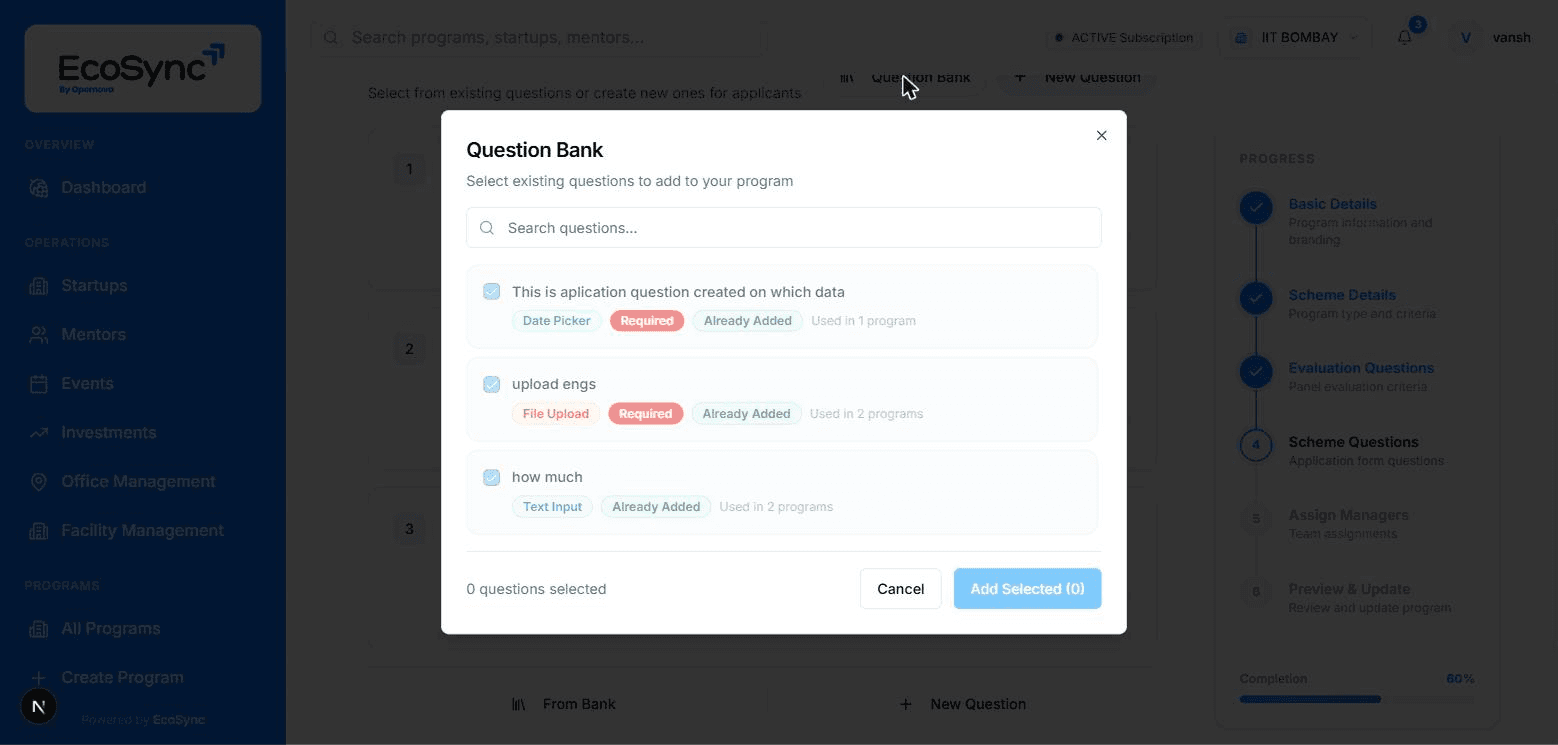
Application forms are assembled from eight question types, drawing on a reusable question bank. The twenty questions you ask on every program are written once and reused, and the handful that are specific to a particular scheme are added on top.
This matters more than it sounds. Most incubators rebuild substantially the same form for every cohort, which is both slow and the reason data from different cohorts cannot be compared.
Eight question types
Text, choice, file upload and the rest - enough to capture what a real application needs without forcing everything into a text box.
Reusable question bank
Write a question once and reuse it across programs, so answers stay comparable between cohorts.
Per-program forms
Each program gets the form it needs. A deep-tech scheme and a student pre-incubation track do not have to share one questionnaire.
Rich text where it helps
Formatting available in longer answer fields, so applicants can structure a response rather than submitting a wall of text.
Twelve statuses and an audit trail
An application is not either open or closed. It is submitted, under review, shortlisted, awaiting documents, referred back, evaluated, approved, onboarded - or rejected at any of those points, for a reason someone will ask about later.
There are twelve statuses, and every transition is recorded with the person who made it and the timestamp. That record is the difference between knowing where an application is and remembering roughly where it was.
Document and change requests with a status
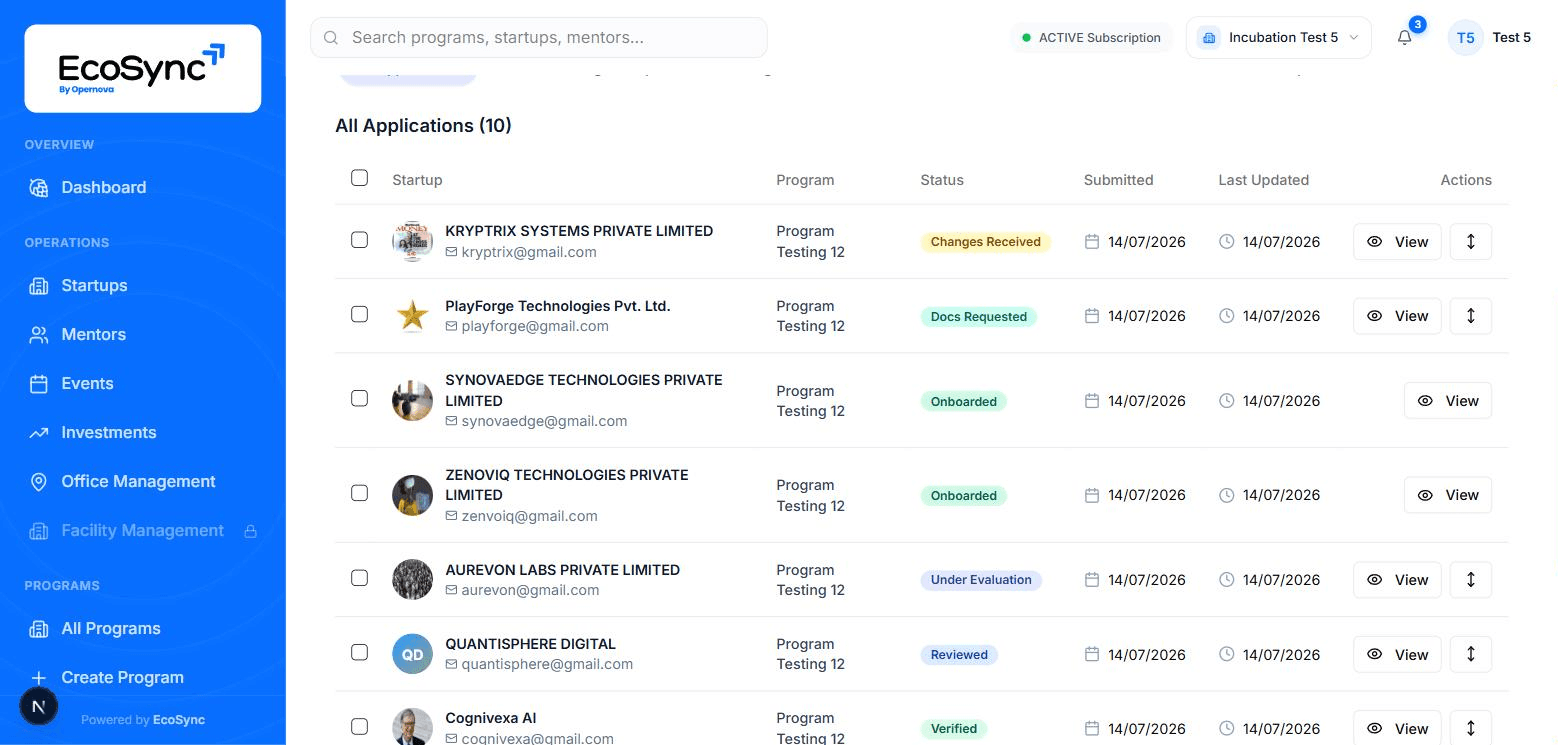
Two loops consume most of the administrative time in an application cycle: asking for a document that was not attached, and asking an applicant to correct something they filled in wrongly.
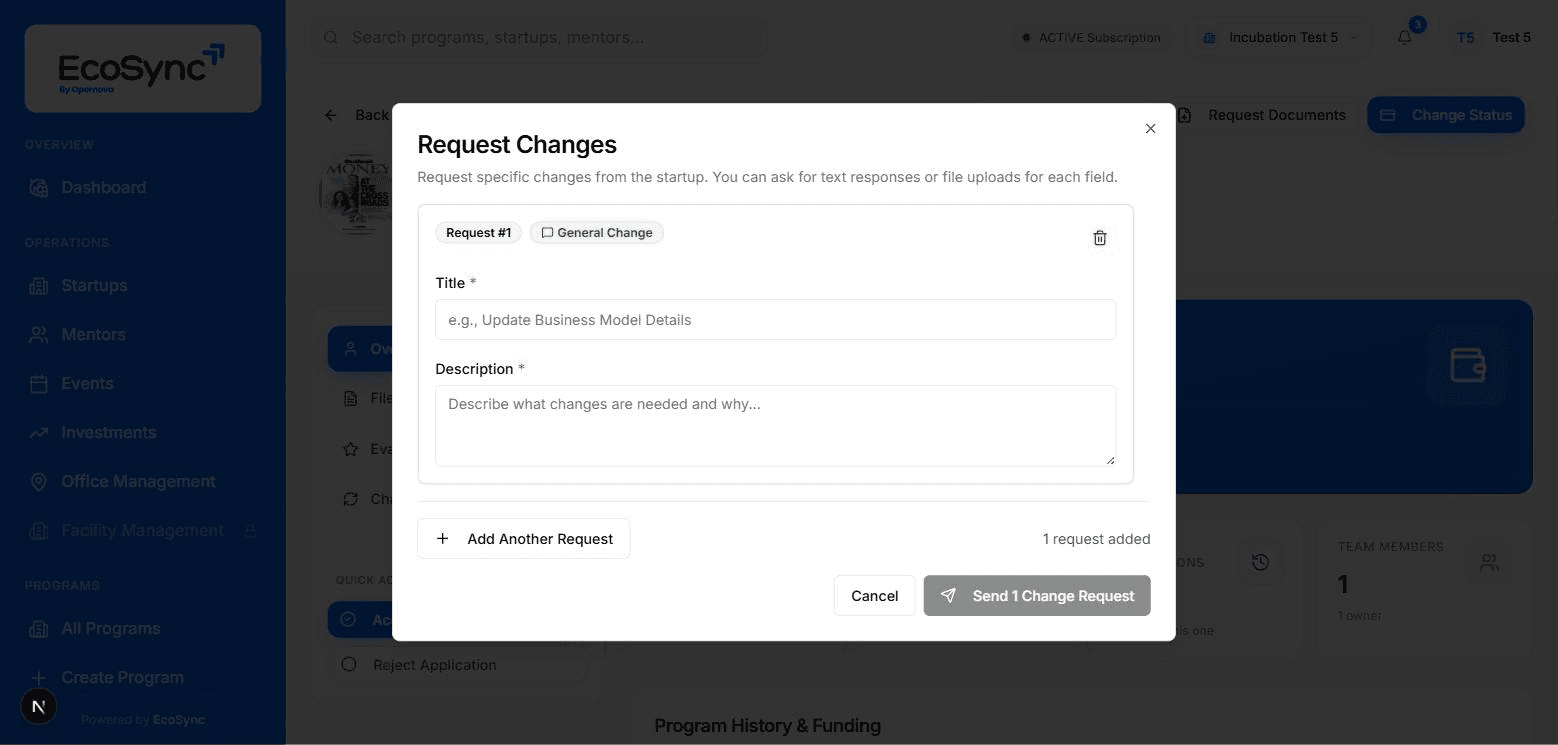
Both are first-class here. A document request is a tracked object with a state, so the outstanding list is a query rather than a search through your sent folder. A change request asks the applicant to revise a specific part of their submission, and carries its own approve, reject and re-request states - so a correction does not mean starting the application again.
Requests can also be issued in bulk, which is what you want when a whole cohort is missing the same certificate.
What happens after acceptance
The point of managing applications properly is that nothing has to be re-entered afterwards.
An accepted application becomes a startup in a batch. Its evaluation record, documents and history stay attached. From there the same profile carries funding requests and disbursements, task boards, office allocation, facility bookings, mentorship associations and data collection responses.
Because the startup is also a profile on the ecosystem network, an applicant you accept is already visible to mentors and investors rather than being a row in your database.
Questions people actually ask
Can each program have a different application form?
Yes. Forms are built per program from eight question types, drawing on a shared question bank - so common questions stay consistent and comparable across cohorts while program-specific questions can be added freely.
How do we chase a missing document?
Raise a document request inside the system. It is a tracked object with its own status, so your outstanding list is always current, and requests can be issued in bulk when a whole cohort is missing the same thing.
Can an applicant fix a mistake without reapplying?
Yes. A change request targets a specific part of the submission and carries approve, reject and re-request states, so a correction is a loop rather than a restart.
Is there a record of who changed an application's status?
Yes. All twelve status transitions are logged with the person and the timestamp, which is what lets you explain a decision months after it was made.
Can we register startups we already know without an application?
Yes. Startups can be added directly to a program or batch, including in bulk, for cases where selection happened outside the platform.
Do accepted applicants have to be re-entered as startups?
No. An accepted application becomes a startup in the batch, carrying its evaluation record, documents and history forward. Funding, tasks, office allocation and mentorship all attach to that same profile.
Related
- Incubation management software
- Panel evaluation
- Documentation: program management
- Documentation: startup management
Guides on this topic
- How to Get Into Y Combinator: Application, Deal and Interview
What YC invests and on what terms, how the application and interview work, what they look for, and an honest view of what acceptance does and does not do for your company.
- The Thiel Fellowship: What It Is and How to Apply
A grant for people under 23 who leave university to build something. What it provides, who it suits, how the application works, and the trade-off nobody discusses honestly.
- Major Startup Accelerators Worldwide, and How to Choose
A survey of well-known accelerator programs, what distinguishes them, and a framework for deciding which - if any - is worth the equity for your specific business.
- How to Write an Accelerator Application That Gets Read
What program reviewers are looking for, how applications are actually assessed at scale, the answers that recur in accepted applications, and the mistakes that end them early.
- DPIIT Startup Recognition: Benefits, Eligibility and Process
What DPIIT recognition actually unlocks, who qualifies, how to apply on the Startup India portal, and why recognition alone does not give you the tax holiday.
- MSME Udyam Registration: Limits, Benefits and How to Register
The revised MSME classification thresholds, what Udyam registration gets you, the automatic reclassification nobody expects, and the step-by-step process. It is free.
Build your application form in the platform
Send us the form you use today. We will rebuild it in EcoSync and run a test application through the pipeline so you can see the document and change loops working.
Book a walkthroughReady to Join
the Ecosystem?
Book a demo
For everyone on the network
For incubators and accelerators
EcoSync is a product of Opernova Technologies LLP.
Running an incubator or accelerator? EcoSync for incubators
© 2026 Opernova Technologies LLP. All rights reserved.