


A startup ecosystem platform for founders, not another feed
You already have a network. What you do not have is one place where the incubator you applied to, the mentor you booked, the investor reviewing your deck and the engineer you are trying to hire can all see the same company profile.
The founder's real problem is not reach. It is repetition.
You fill in the same company details on an incubator application form. Then again on a funding request. Then again for the investor who asked for your metrics. Then again on a job post, because the candidate wants to know what the company does.
Each one lives in a different tool, so each one goes stale at a different rate. Six months later the traction number in your application is wrong, the deck in the investor's inbox is two versions old, and nobody can tell which is current.
The fix is not a better form. It is having one company record that every one of those surfaces reads from.
One company profile, read by everyone who needs it
Your startup workspace holds the team, the documents, the pitch deck, the metrics and the milestones. When you apply to a program, the incubator sees that record. When an investor opens a deal, they see it too - at the level of detail you have granted.
Update it once and it is current everywhere it appears.
Company workspace
Team members with roles, files, pitch decks and a public page that doubles as your profile on the network.
Reporting that is not a spreadsheet over email
Incubators and investors ask for specific numbers on a set cadence, and you answer the request in one place instead of rebuilding a deck each time. What you send is what they see, dated, so nobody is working from a figure they were emailed in March.
Applications that carry your data
Apply to incubation programs without retyping the company. If the reviewer needs something more, they request a change or a document against the application itself.
Funding requests
Raise a structured funding request to a program you are part of, and follow it through approval and staged disbursement rather than chasing it over email.
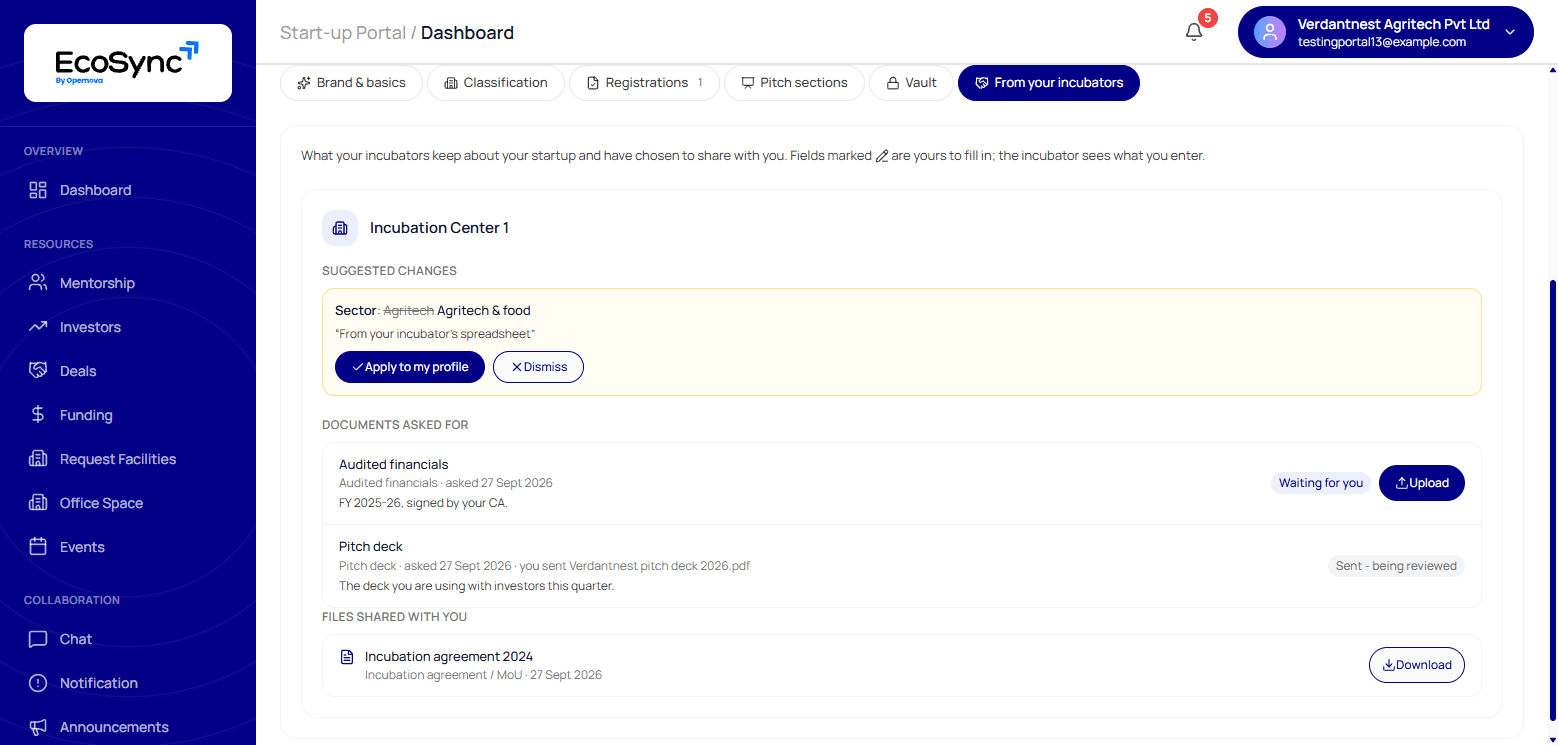
When your incubator already has you on file
Incubators keep records of the startups they have supported, often going back years. When yours moves those records here, they stay yours to run.
If the incubator kept a record of your startup, it can invite you to claim it while you are still with them; the record then becomes your company profile, and they see only what you choose to share. If their records match a startup you already run here, nothing is shared until you confirm it is you - or say it is not.
Suggestions, not edits
When an incubator's records disagree with your profile, they send a suggestion. You apply it or dismiss it; nothing changes until you do.
Documents asked for, in one place
A document your incubator needs arrives on your company profile. Upload it there, and see whether it was approved or why a new file is needed.
Files they share with you
Agreements and certificates the incubator uploads for you appear on your profile to download, next to the fields they have asked you to keep.
The people you need are on the same platform
Mentors publish real availability and session types, so booking one is picking a slot rather than starting a negotiation. Investors run their deal flow here, which means a warm path to one is visible rather than guessed at. Engineers, designers and freelancers have profiles you can search.
- Book mentors by session type or buy a package, and meet over video without leaving the platform
- See which of your connections already work at a company before you apply or pitch
- Post jobs with screening questions and review applications with attached resumes
- Join communities and attend events where the people you are trying to reach already are
- Track deals with investors - documents, meetings, notes and stage, in one thread
Questions people actually ask
Is this just a social network for startups?
No. The feed and communities are one part. Behind them sit workspaces: a company profile with metrics and documents, incubation program applications, funding requests, mentorship booking, hiring, and deal tracking with investors. Most of what a founder does here is not posting.
Do I need to be in an incubator to use it?
No. You can create a company profile, book mentors, hire, join communities and attend events without being part of any program. If you later apply to one, your existing profile carries over.
Who can see my company data?
Your public page is visible on the network. Documents, metrics and deal materials are shared deliberately - with a program you have applied to, or an investor you are in a deal with - and permissions are set per record rather than globally.
My incubator says it already has my startup in its records. What happens?
Nothing changes on your side until you act. If they invite you to claim the record they kept, accepting makes it your company profile. If their records point at a startup you already run here, you are asked to confirm it is you before anything is shared, and you can say it is not. Either way, changes they want to your details reach you as suggestions.
What does it cost for a founder?
Plans are configured per deployment and the current structure is visible after you sign in. Incubators and accelerators looking for their own branded workspace should contact us directly.
Related
Guides on this topic
- How Cloud Computing Is Transforming Modern Software Development
Cloud computing has revolutionized how software is built, deployed, and scaled. This article explores how cloud technologies enable faster development cycles,.
- How Modern Software Architecture Enables Scalable Digital Platforms
Behind every successful digital platform lies a carefully designed software architecture that supports scalability, reliability, and long-term growth.
- The Role of Data Analytics in Building Intelligent Digital Platforms
Modern digital platforms generate vast amounts of data every second. Businesses that can transform this data into meaningful insights gain a significant.
- Building Scalable SaaS Platforms: Architecture, Strategy, and Best Practices
Software-as-a-Service (SaaS) has become the dominant model for modern digital products. Building a successful SaaS platform requires more than coding.
- Why APIs Are the Backbone of Modern Digital Platforms
APIs power the modern digital ecosystem by enabling software platforms to communicate, integrate, and scale efficiently.
- How Agile Development Helps Startups Build Better Products Faster
Agile development has transformed how modern software products are built. Instead of long development cycles, agile teams deliver incremental improvements.
Put the company in one place
Create a profile, and let the incubators, mentors and investors you deal with read the same record you do.
Create an accountReady to Join
the Ecosystem?
Book a demo
For everyone on the network
For incubators and accelerators
EcoSync is a product of Opernova Technologies LLP.
Running an incubator or accelerator? EcoSync for incubators
© 2026 Opernova Technologies LLP. All rights reserved.