


Startup evaluation software with a weighted panel rubric
Define a rubric of weighted, scored criteria. Assign panel members to specific programs. Let them score independently, and get a total weighted score with the per-evaluator breakdown kept intact - so a selection decision is still explainable a year later.
The spreadsheet problem is that it looks like it is working
Two evaluators score an application out of ten. One gives it a seven because the team is strong. The other gives it a seven because the market is large. The average is seven, and the number is meaningless - it has flattened two unrelated judgements into one figure that cannot be compared with anything.
Now do that across eighty applications, five evaluators and two cohorts, and try to explain to a governing body why application forty-one was selected over application nineteen.
The fix is not more discipline from evaluators. It is a rubric that makes the criteria explicit and weights them before anyone starts scoring.
How the rubric works
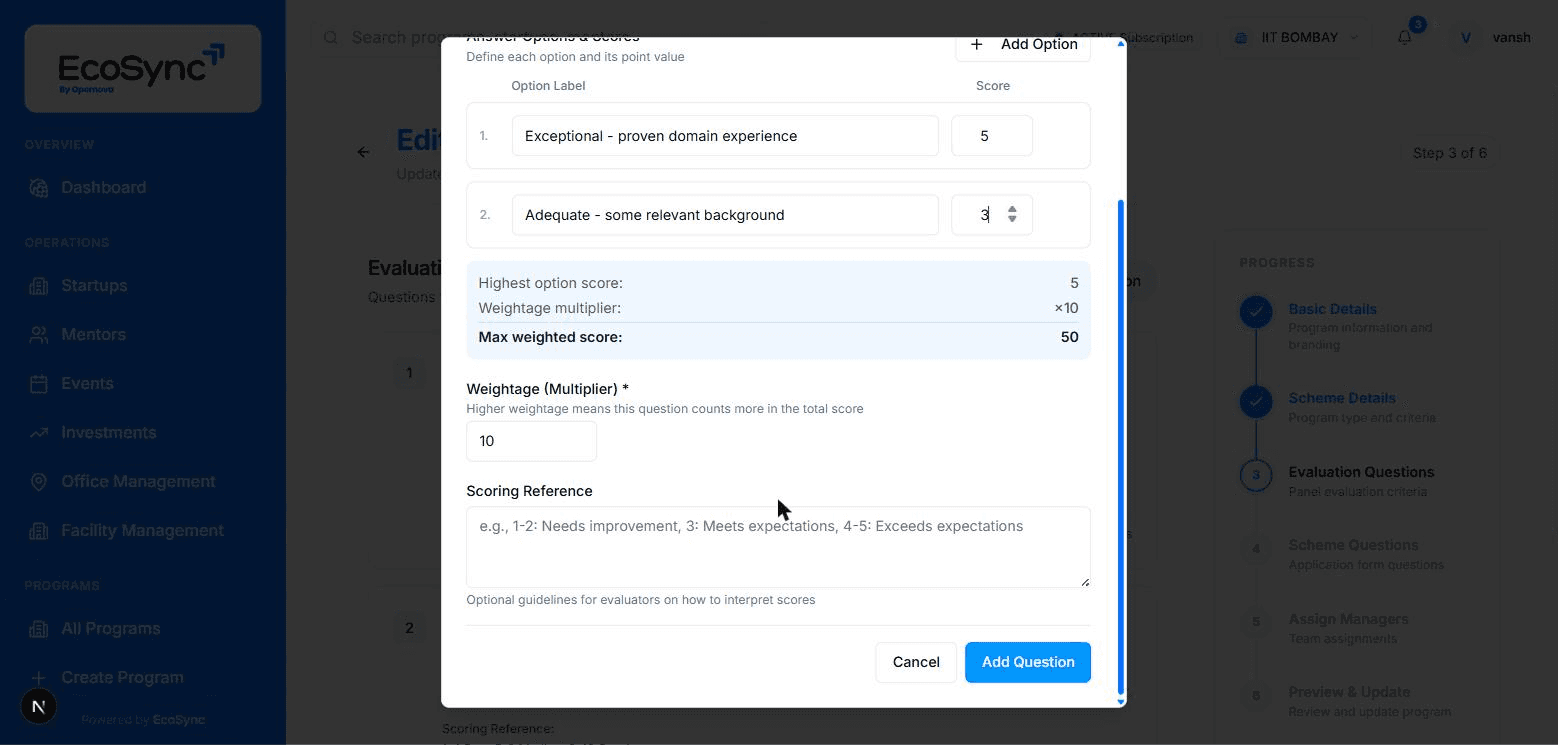
You build a set of evaluation questions. Each question has a weight, reflecting how much it should count towards the total. Each question has scored options, so an evaluator picks a defined level rather than inventing a number.
The result is that every evaluator is answering the same question, on the same scale, with the same weighting - which is what makes their scores comparable to each other, and comparable across cohorts.
Weighted criteria
Each criterion carries an explicit weight, so team quality and market size contribute in the proportion you decided in advance rather than the proportion each evaluator happens to feel.
Scored options, not free numbers
Evaluators select from defined levels against each criterion. This removes the drift between a generous scorer and a harsh one.
Independent scoring
Each panel member scores on their own. Nobody sees another evaluator's score first, so the first opinion entered does not anchor the rest.
Aggregation that keeps the detail
You get the total weighted score, per-question averages, and each evaluator's individual breakdown - the disagreement stays visible instead of being averaged away.
Panel members without portal access
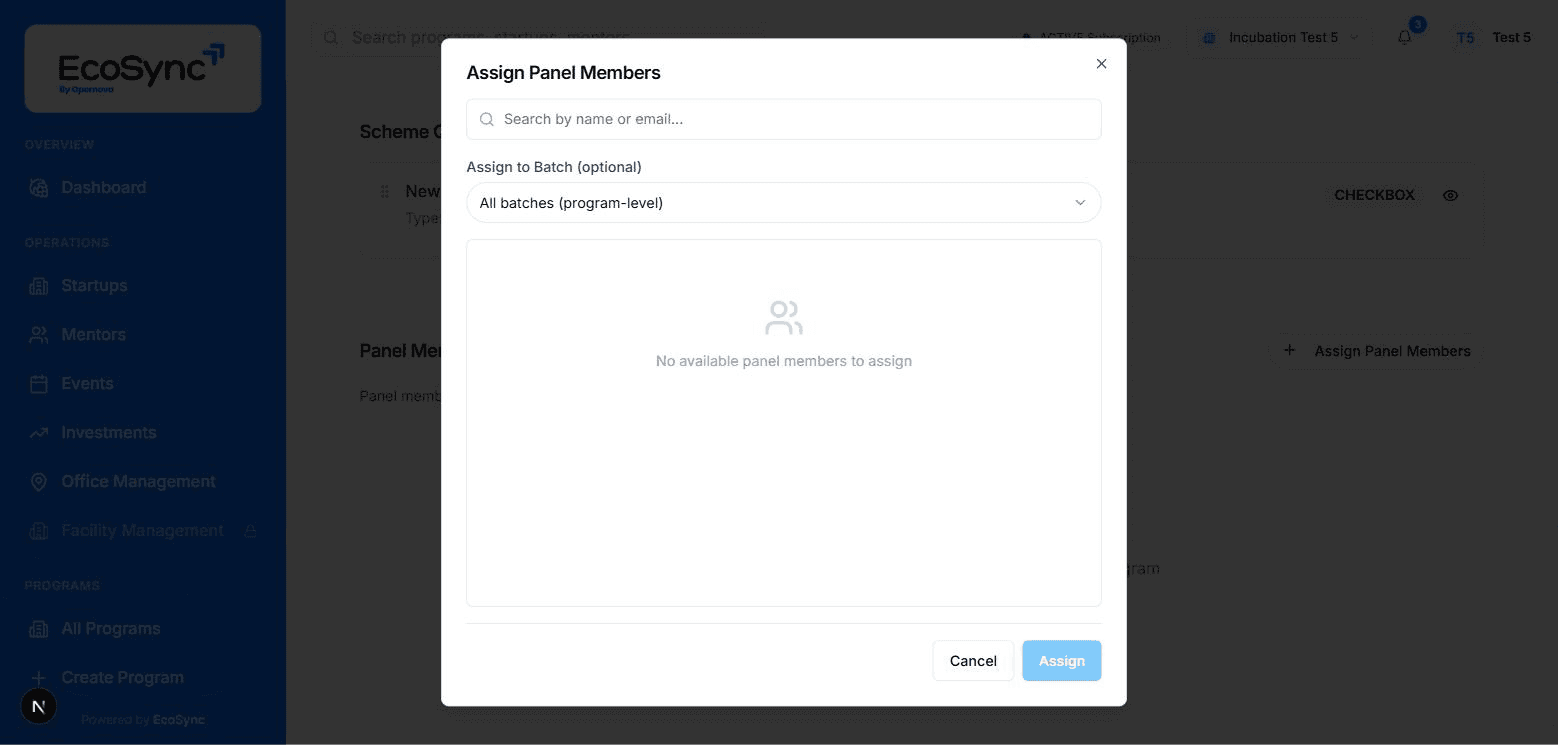
The best evaluator for a deep-tech cohort is often someone who does not work at your incubator and should not have access to your funding records.
Panel members are assigned to specific programs, and can only see and evaluate applications inside those programs. They can be added without being granted a full portal role - so bringing in an external domain expert for one program is a small act, not a security decision.
The audit trail is the point
Evaluation scores are only half of a defensible selection process. The other half is the record of what happened to each application and who did it.
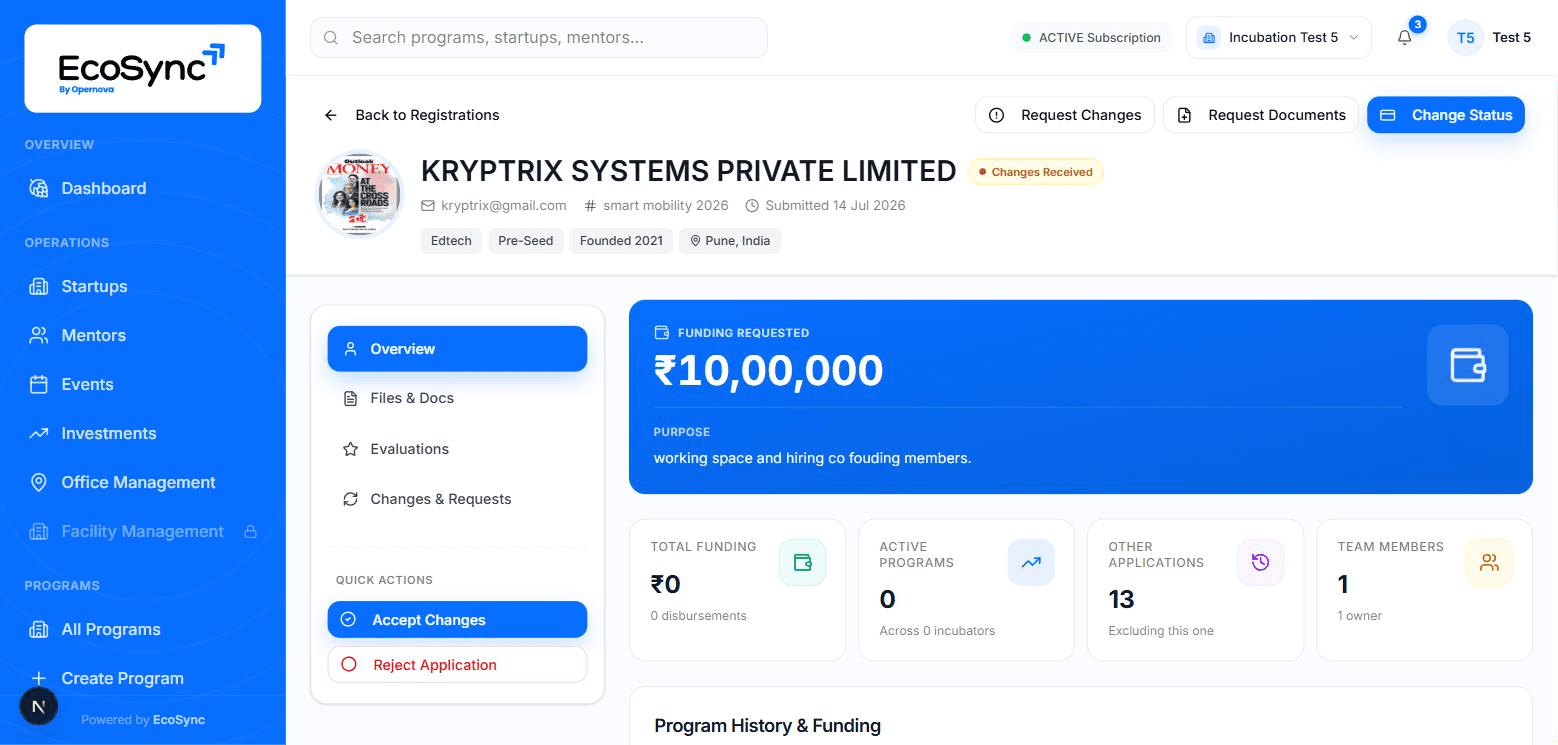
Applications move through twelve statuses, and every change is recorded with the person and the timestamp. Requests for changes and requests for documents each carry their own state, so an application that stalled has a visible reason. Combined with the scoring breakdown, you can reconstruct any selection decision without relying on anyone's memory.
Where evaluation sits in the wider program
Evaluation is not a standalone step. The rubric is defined while you are building the program, alongside the application form, so the questions you ask applicants and the criteria you judge them on are designed together.
After selection, the same records carry forward - the startup that was evaluated becomes a startup in a batch, with its funding, tasks, office allocation and mentorship all hanging off the same profile. Nothing is re-entered.
Questions people actually ask
How many panel members can evaluate one application?
Multiple evaluators can be assigned and each scores independently. The system aggregates their scores into a total weighted score while retaining each evaluator's individual breakdown, so you can see both the outcome and the level of agreement behind it.
Can external experts evaluate without full portal access?
Yes. Panel members can be added without being granted a full role, and they are assigned to specific programs - so they can only see and score applications within those programs. This is the intended way to bring in a domain expert for a single cohort.
Are scores comparable between different cohorts?
Yes, provided the rubric is the same. Because criteria carry explicit weights and use defined scored options rather than free-form numbers, the same rubric applied to Batch 1 and Batch 5 produces figures you can legitimately compare.
Can we change the rubric after applications have come in?
The rubric is defined as part of the program, and evaluation questions can be added and updated. As a matter of practice, changing weights midway through scoring a cohort undermines comparability within that cohort - so it is worth settling the rubric before evaluation opens.
What stops one evaluator's score from influencing another's?
Evaluators score independently rather than into a shared view, so the first score entered does not anchor the others. Aggregation happens after the fact.
Is there a record of who made each decision?
Yes. Every application status change is logged with the person and the timestamp, alongside the evaluation record, change requests and document requests. That combined history is what makes a selection decision explainable months later.
Related
- Incubation management software
- Application management
- Documentation: evaluation panel
- Documentation: creating a program
Guides on this topic
- How Startup Valuation Actually Works
Pre-money, post-money, and why early-stage valuation is negotiated rather than calculated. The methods investors use, what really moves the number, and why chasing a high valuation can backfire.
- The Financial Metrics Investors Actually Ask About
A stage-by-stage guide to the numbers that come up in real investor meetings - from pre-seed through Series B - and the answers that signal you understand your own business.
- What Incubators Look For in Startup Applications
Written from the evaluator's side of the table: the rubric applications are actually scored against, and the six answers that decide whether you make the shortlist.
- How to Build a Pitch Deck That Gets a Second Meeting
The slides investors actually read, in the order they read them. What belongs on each, the three slides founders get wrong, and what the deck is really being judged on.
- Investor Due Diligence: What They Ask For and How to Be Ready
The documents investors request, the problems they find, and how to prepare a data room before you start raising - because reconstructing this under time pressure kills rounds.
- The Role of Mentorship in Building Successful Startups
Behind many successful startups is a strong mentorship network. Experienced founders and industry experts provide guidance that helps entrepreneurs avoid.
See a rubric scored across a real panel
Bring a rubric you already use, or one you have been meaning to write down. We will build it in the platform and score a live application with it.
Book a walkthroughReady to Join
the Ecosystem?
Book a demo

For everyone on the network
For incubators and accelerators
EcoSync is a product of Opernova Technologies LLP.
Running an incubator or accelerator? EcoSync for incubators
© 2026 Opernova Technologies LLP. All rights reserved.