


Office space and facility management software
Turn desks, cabins, labs and meeting rooms into a managed line rather than a whiteboard. Five pricing tiers, deposits, recurring rent, payouts to your own account, and a booking workflow with approvals.
Space is usually an incubator's least-managed asset
Most incubators have real estate, and most manage it informally. Who has which desk lives in someone's head or a shared sheet. Rent is invoiced manually, or forgotten. Lab access is negotiated in a WhatsApp group. Meeting rooms are double-booked routinely enough that nobody is surprised.
None of this is a crisis, which is exactly why it persists - and why the revenue it should be generating quietly does not.
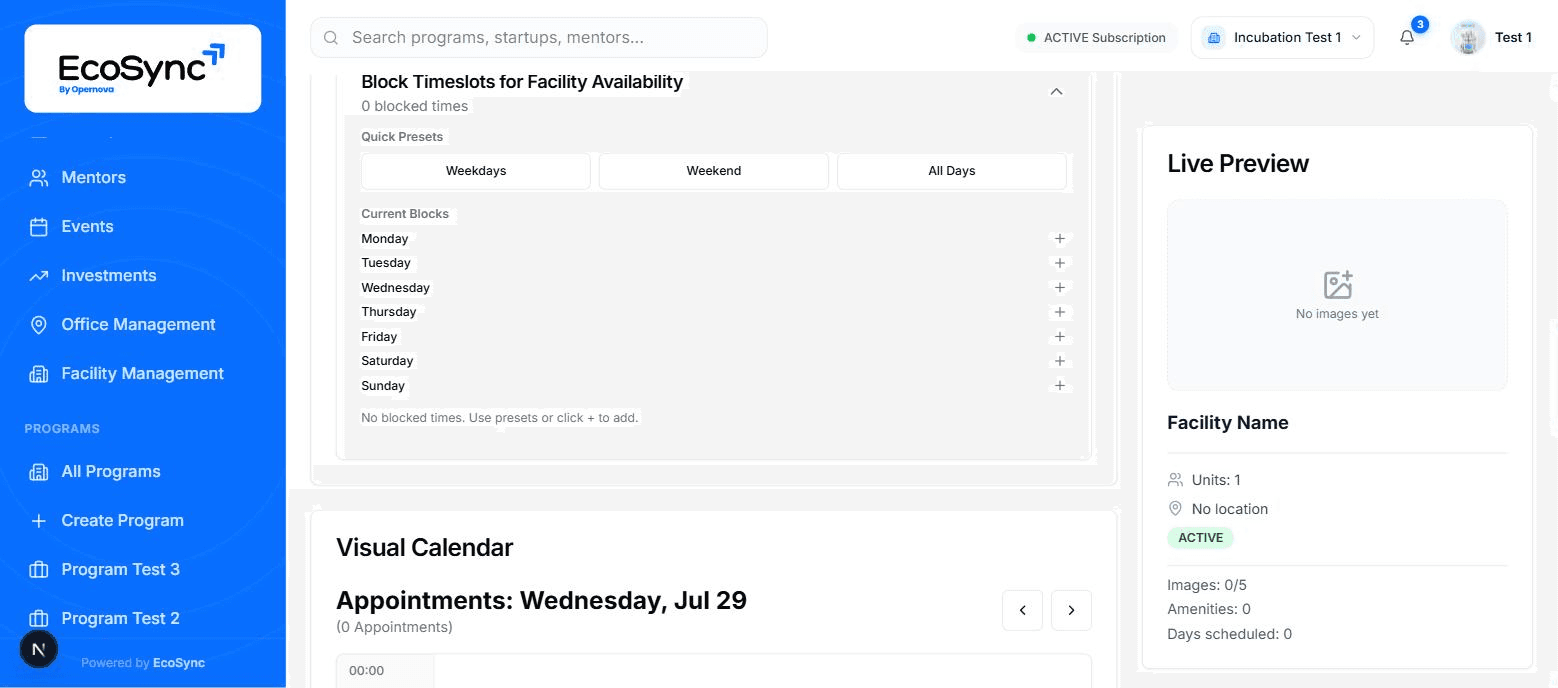
Offices with real commercial terms
List each office, desk or cabin with the terms it is actually let on. Five pricing tiers cover the range from a hot desk to a private cabin. Deposits are handled, and ongoing rent runs as a recurring subscription rather than an invoice someone has to remember to raise.
Revenue is transferred to your own account after verification, so income from space is not sitting somewhere you cannot see.
Five pricing tiers
From hot desk to private cabin, with the terms attached to the listing rather than kept in a separate agreement.
Deposits and recurring rent
Take a deposit up front and run rent as a subscription, so collection is not a monthly manual task.
Payouts to your account
Office revenue is transferred to your own account after verification, with a settlement record you can reconcile.
Allocation and occupancy
See who is in which space, when their allocation ends, and what is free - without asking anyone.
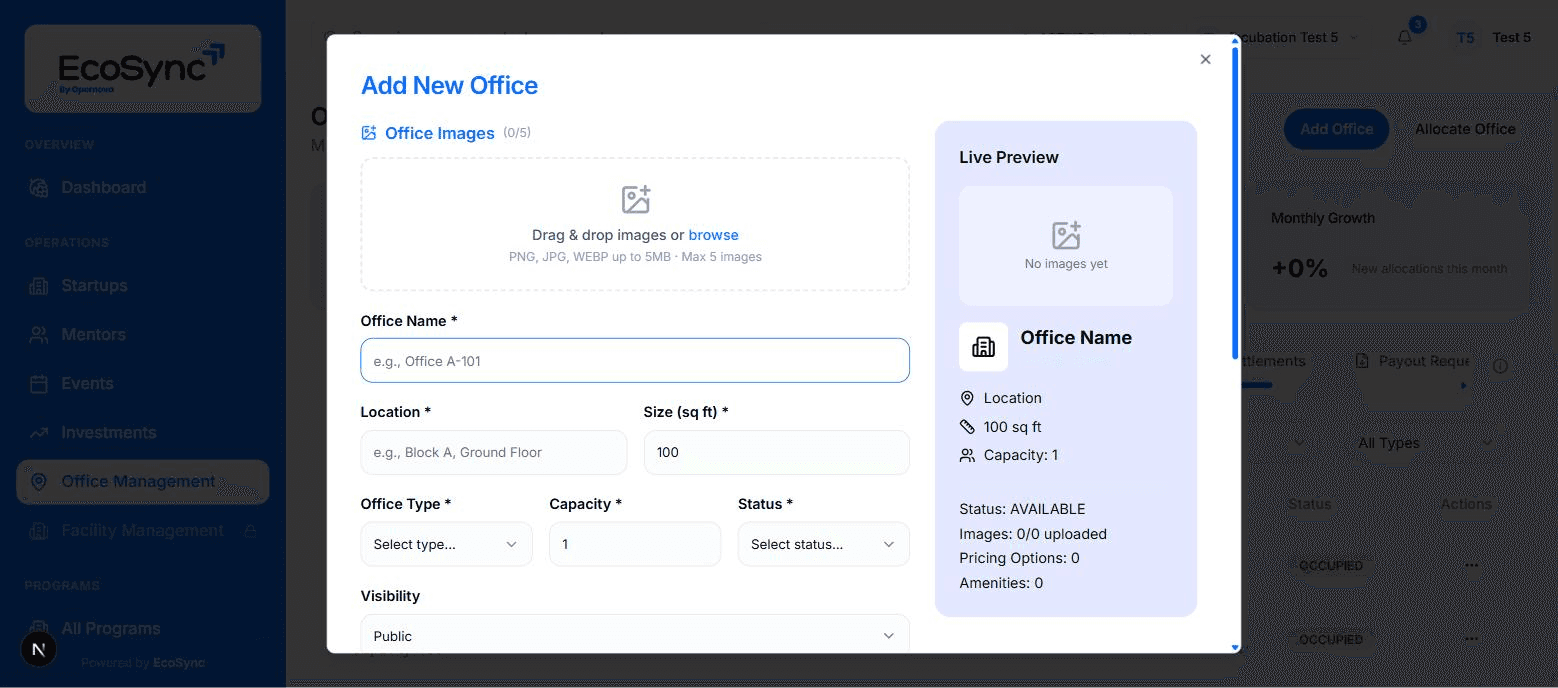
Requests and allocations, with a state
A startup requests space. Someone approves it. The allocation runs for a period, gets extended, or ends. Each of those is a step with a status rather than a conversation.
Allocations can be extended or ended explicitly, so the question of who is currently occupying what has an answer that does not depend on anyone's recollection. Offline payments can be recorded where a startup has paid you outside the system, which keeps the record complete rather than clean-but-wrong.
Facilities: labs, equipment and meeting rooms
Facilities work differently from offices. Nobody rents a lab for six months - they book it for two hours on a Thursday.
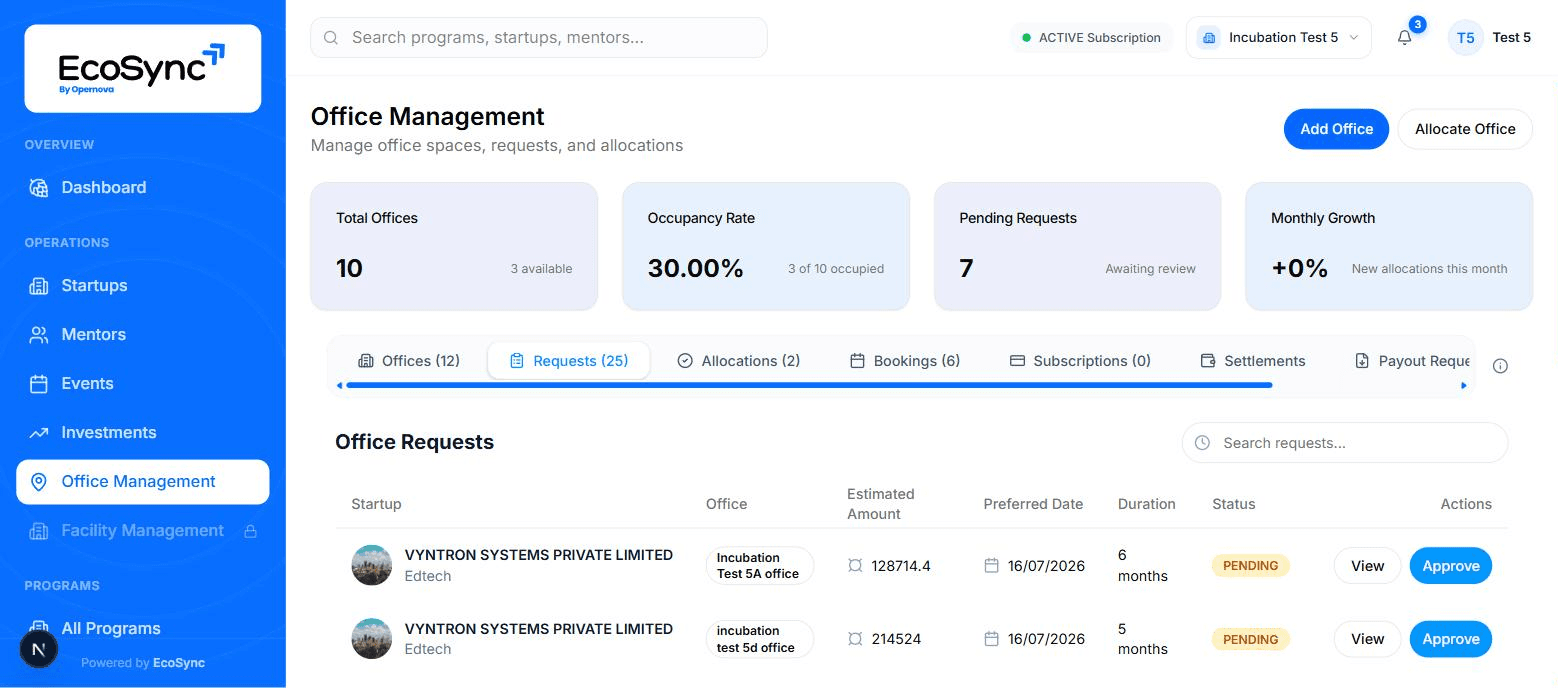
Facilities are bookable against day-of-week time slots, with an approval workflow where the facility warrants one. Slots can be blocked out for maintenance or internal use. Bookings can be approved, rejected, rescheduled or cancelled, each as a recorded action, and reporting shows utilisation - which is usually the first time anyone finds out whether the expensive equipment is actually being used.
Day-of-week time slots
Define real availability per facility rather than treating everything as bookable all the time.
Approval workflow
Require approval where a facility needs supervision, and skip it where it does not.
Blocked slots
Take a facility out of circulation for maintenance or internal use without deleting it.
Utilisation reporting
See which facilities are used and which are not, which is the argument you need at budget time.
Discoverable beyond your own cohort
Space you list can be discovered and booked by startups on the wider ecosystem network, not only the ones already in your programs.
For an incubator with spare capacity that is a straightforward commercial upside: the desks are already there, and the booking, payment and payout path already exists. For a startup, it means finding a desk in a real incubator rather than a generic coworking floor.
Questions people actually ask
How many pricing tiers can an office space have?
Five, covering the range from a hot desk through to a private cabin. Deposits are supported, and ongoing rent can run as a recurring subscription rather than a manually raised invoice.
Does office revenue come to us directly?
Yes. Revenue from space you let out is transferred to your own account after verification, with a settlement record for reconciliation.
How is a lab or meeting room different from an office?
Facilities are booked in slots rather than allocated for a period. You define bookable time slots per day of the week, optionally require approval, and can block slots out for maintenance. Bookings can be approved, rejected, rescheduled or cancelled, and utilisation is reported.
Can we record a payment a startup made outside the system?
Yes. Offline payments can be recorded against an allocation, so the record stays complete rather than looking tidy while being incomplete.
Can startups outside our programs book our space?
Yes, if you want them to. Listed space is discoverable to startups on the wider ecosystem network, which is a practical way to use spare capacity you already have.
Can we see occupancy and utilisation?
Yes. Occupancy across offices and utilisation across facilities are both reported, including which allocations are ending - which is what you need for both planning and budget conversations.
Related
Guides on this topic
- How Incubators Can Manage Startup Programs More Efficiently
Startup incubators play a crucial role in supporting early-stage companies, but managing applications, evaluations, mentorship, and resources can quickly.
Put your floor plan into the platform
Tell us what space you have and how you currently charge for it. We will list it, allocate it and run a rent cycle so you can see the payout and settlement record.
Book a walkthroughReady to Join
the Ecosystem?
Book a demo
For everyone on the network
For incubators and accelerators
EcoSync is a product of Opernova Technologies LLP.
Running an incubator or accelerator? EcoSync for incubators
© 2026 Opernova Technologies LLP. All rights reserved.